Isn’t it funny that as children, we’d kick and scream bloody murder when our parents made us learn Chinese but now that we’re parents, we’re doing the same to our kids? We know the Chinese in Taiwan will be a gazillion times harder than what we ever learned here, so we’re trying our best to prepare the boys.
We started them with online Chinese classes during the pandemic. When school opened back up, we enrolled them in the after school Chinese program. The actual language instruction time isn’t much; it was 30 minutes each week for the online classes, and 1-2 hours each day in the after school program.
Another challenge is that the Chinese taught here is mostly Chinese Mandarin and not Taiwanese Mandarin. While the two languages are very similar, Chinese Mandarin uses simplified characters and Taiwan uses traditional. Chinese Mandarin also uses pinyin while Taiwan uses bopomofo, or zhuyin. The boys have been learning Chinese Mandarin at school.
Knowing bopomofo is critical if you attend school in Taiwan. It’s the Taiwanese alphabet phonetic system, so it’s like Americans having to know their ABC’s. Even though my Chinese is limited, I knew I had to at least teach C and O bopomofo.
I first purchased a cute set of bopomofo flashcards on Etsy. Learning 4-5 alphabets a day, I taught myself bopomofo before teaching the boys. They picked it up within 3 weeks.

But the challenge was (and still is) reading bopomofo when the alphabets are strung together. It’s one thing to know your ABCs, but it’s another endeavor to know how to read. On top of this, there are the 5 tones in Chinese which the boys yet have to master.
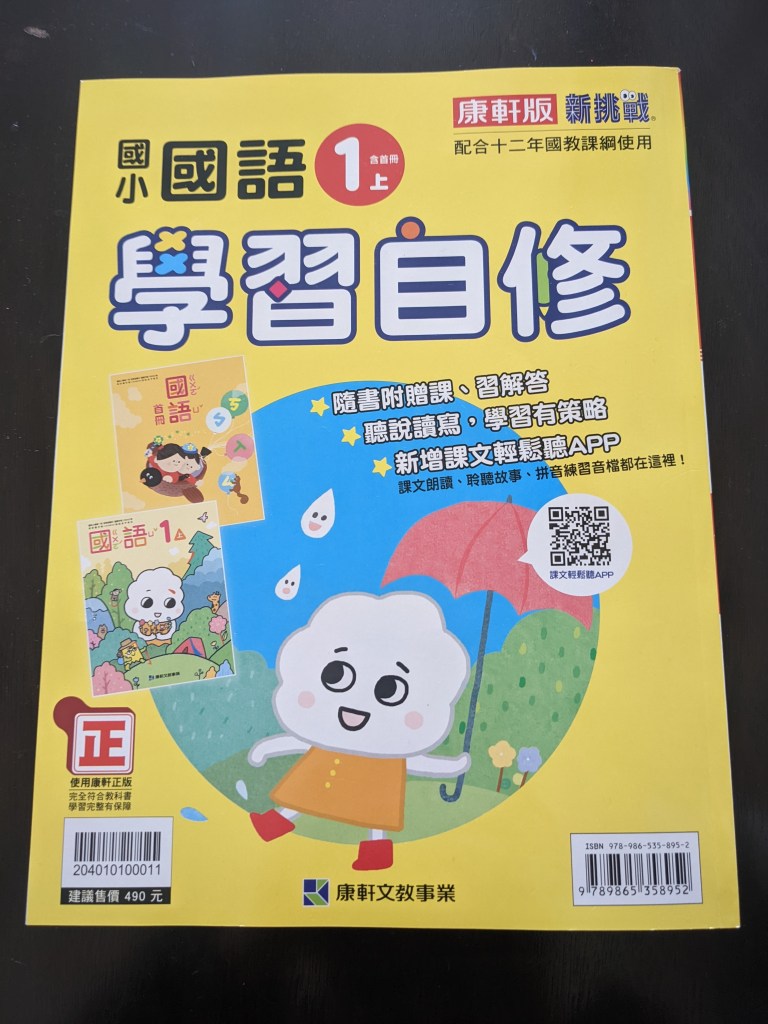
A mom living in Taiwan suggested that I buy a grade 1 textbook to see what the curriculum is like. I purchased a self-study textbook from Kang Xuan, one of Taiwan’s main textbook publishers. The book itself was cheap (~$13 USD) but combine that with international shipping and it came out to $45. What made things worse was that I accidentally bought two copies (d’oh!) because I thought the company cancelled my order. I was eventually able to sell the second copy but at a loss. So my copy of the textbook was actually more like $65, eek.
Unsurprisingly, grade 1 Taiwanese Chinese is pretty damn hard. The first section is purely bopomofo. The boys and I have been trying to do a little each night, but it’s daunting. Even though we can read the bopomofo, there are times we don’t understand what we’re reading.
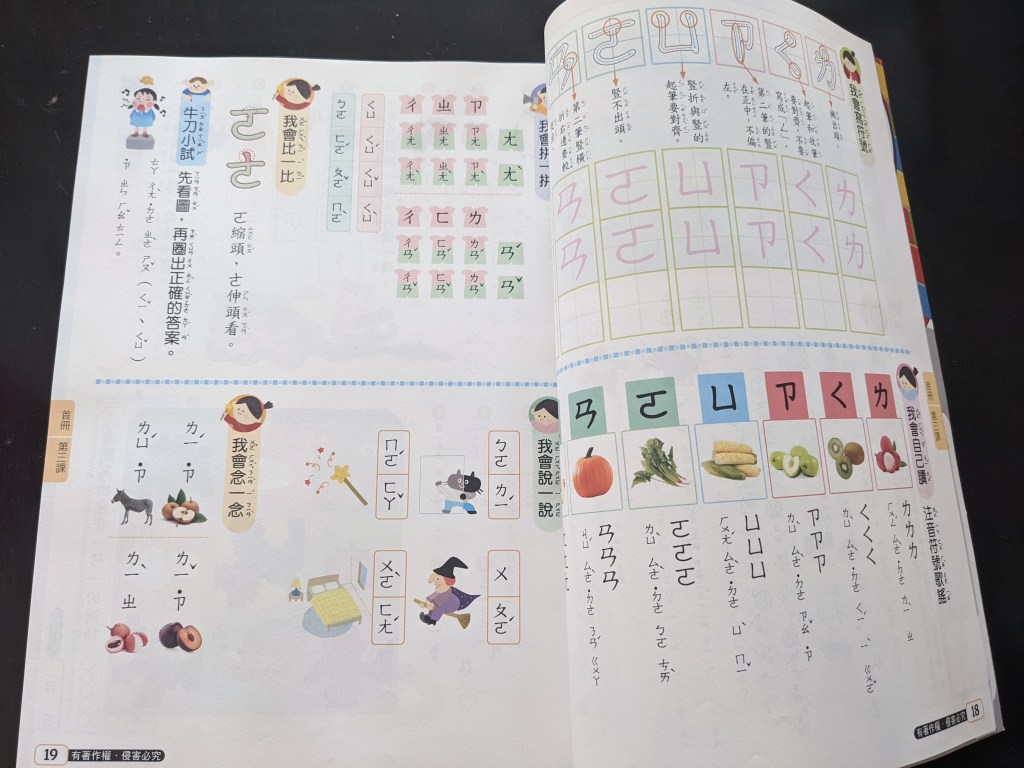
I much prefer pinyin because it uses Roman alphabets, which is more natural for us to read. With bopomofo, it takes more effort for me to convert the alphabet into the right sounds in my head.
The remaining sections in the textbook are all in Chinese. This is definitely not the same as 1st grade Chinese here in the US, where students are likely learning simple words like 吃飯, 說話, 前面. The textbook uses complex vocabulary and phrases (at least to me they are!). It’s expected because these books are for native Mandarin speakers – it’s just more worrisome for us.

In hindsight, buying the textbook wasn’t the best idea. It’s hard for even me to digest, so how could I use it to teach the boys? I should’ve listened to my parents and learned Chinese when I had the opportunity. Sorry Mom!
Later, I found a free resource with PDF textbooks geared towards Chinese learners. The books have English instructions, with both pinyin and bopomofo. The exercises are a slow and easy ramp up, much more manageable for beginners.

Baba thinks our efforts are futile. The boys will struggle in school no matter what, and I don’t doubt that. In a highly competitive and test-centric school culture like Taiwan, we’ll have to emphasize to the boys that they are doing this for the experience. It doesn’t matter what their grades are. What matters to us is that they remain open-minded, make new friends and absorb as much of the language and culture as they can.
I just hope they’ll remember this when they’re crying over 4 hours of homework each day 😅.

 Hongs Abroad