Ramblings

Becoming Bilingual

Before coming to Taiwan, the boys had minimal exposure to Chinese. They took several online classes (inconsistently) and went to an after school Chinese program that had only one hour of language instruction each day. We tried to supplement with Chinese books and shows at home but both boys showed little interest. We also spoke English exclusively at home because I was not confident in my Chinese at all.

After almost one year of public schooling in Taiwan, two things have proved to be true:

  1. Kids are truly like sponges!
  2. There is no better way to learn a new language than in an immersive environment.

At the start of the school year, I had trained both kids to introduce themselves in Chinese (their name, age, where they’re from), but that was pretty much all they could say. They could not understand what was going on in class and had to depend on classmates and teachers to help them translate. C could read/write a few characters, but O could barely remember to write his name in Chinese.

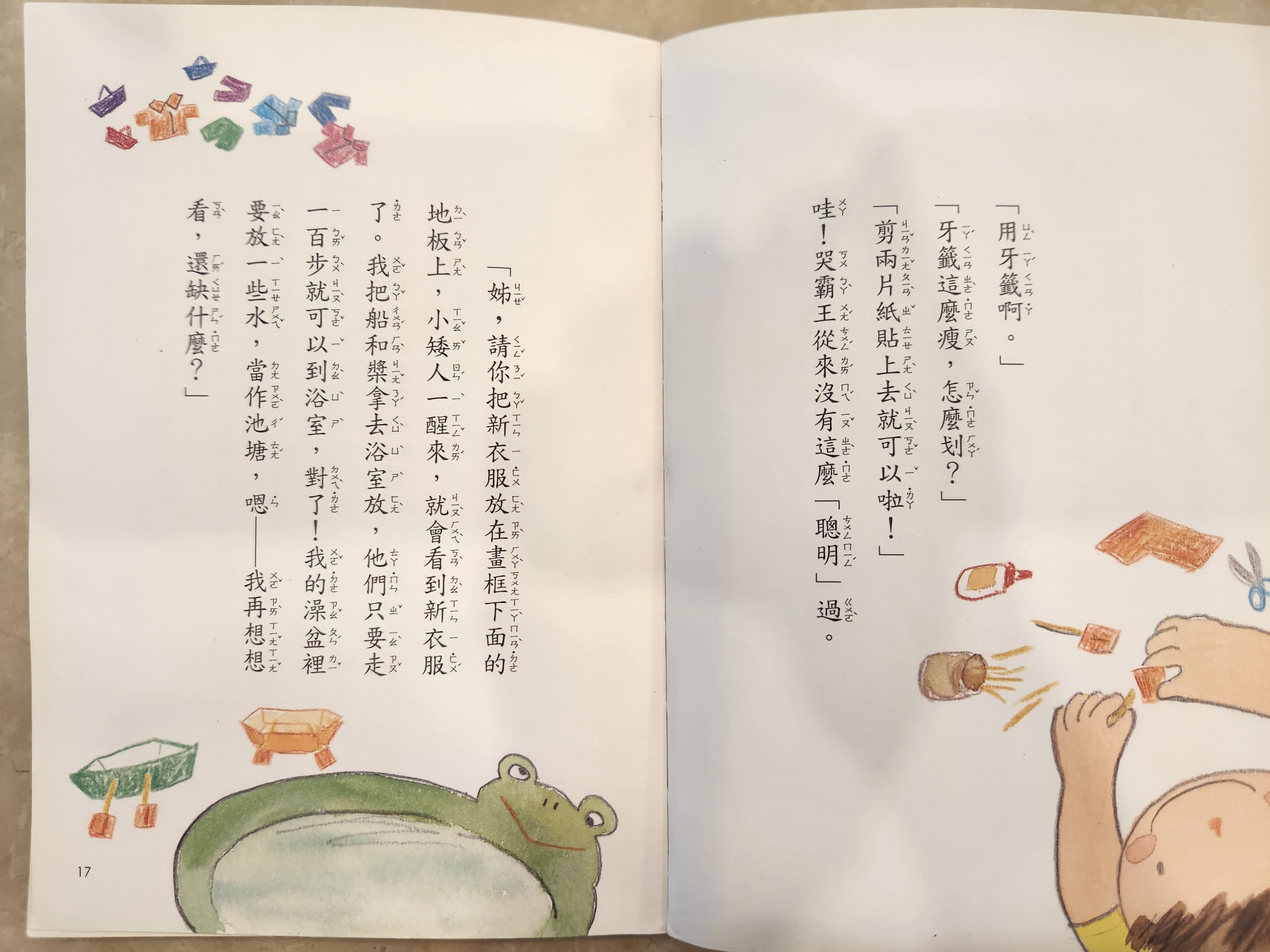
Flash forward to nine months later, C and O can understand their teachers, chat with friends, and read/write basic Chinese. O can do homework all by himself, from reading the problems to writing the answers. O’s teacher no longer needs to translate for him, and he still gets good grades on his tests and homework. With the help of zhuyin, O can also read a lot of text (see below for one of his assigned reading books) though he probably only understands 60% of it at this point.
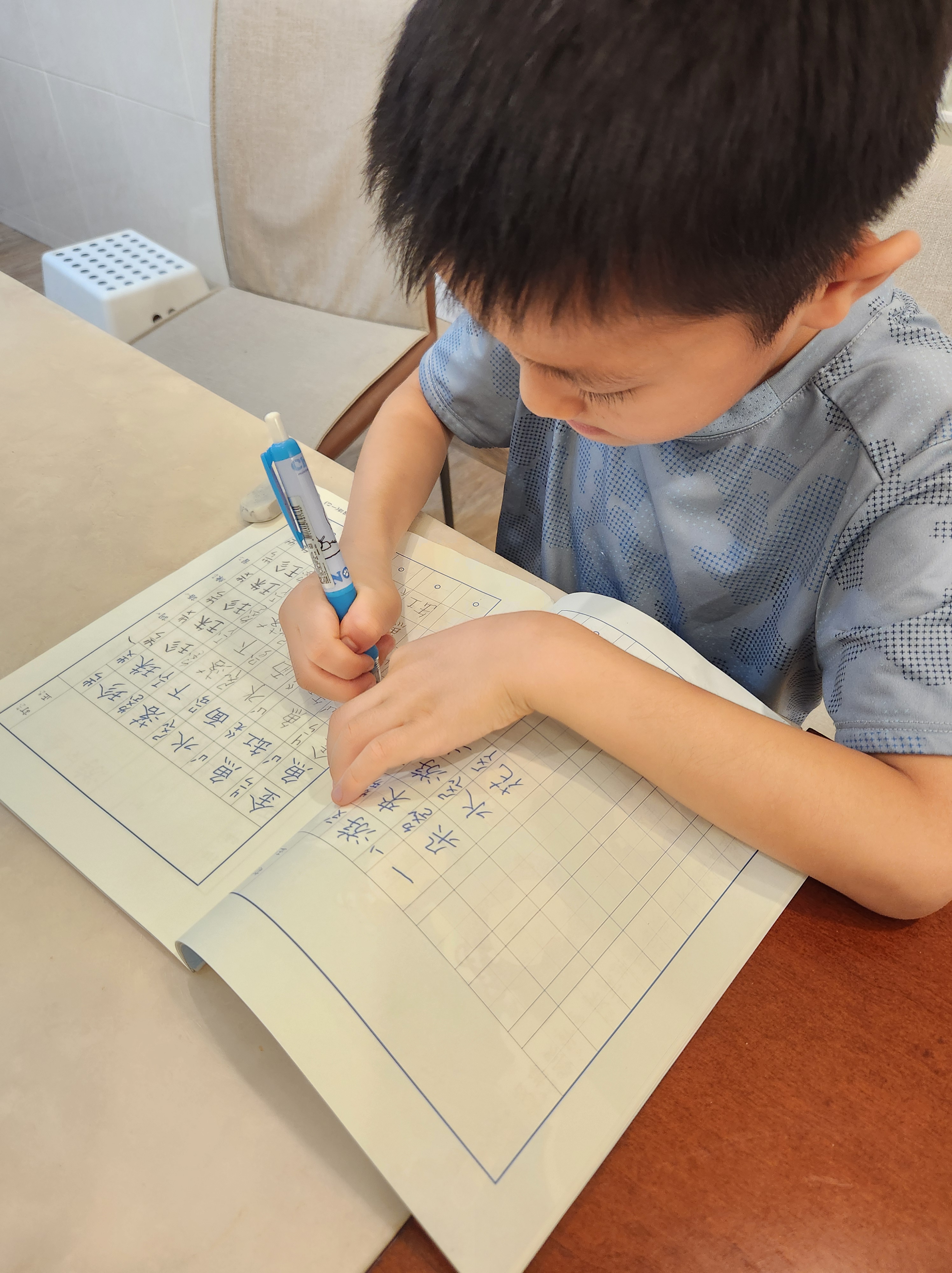
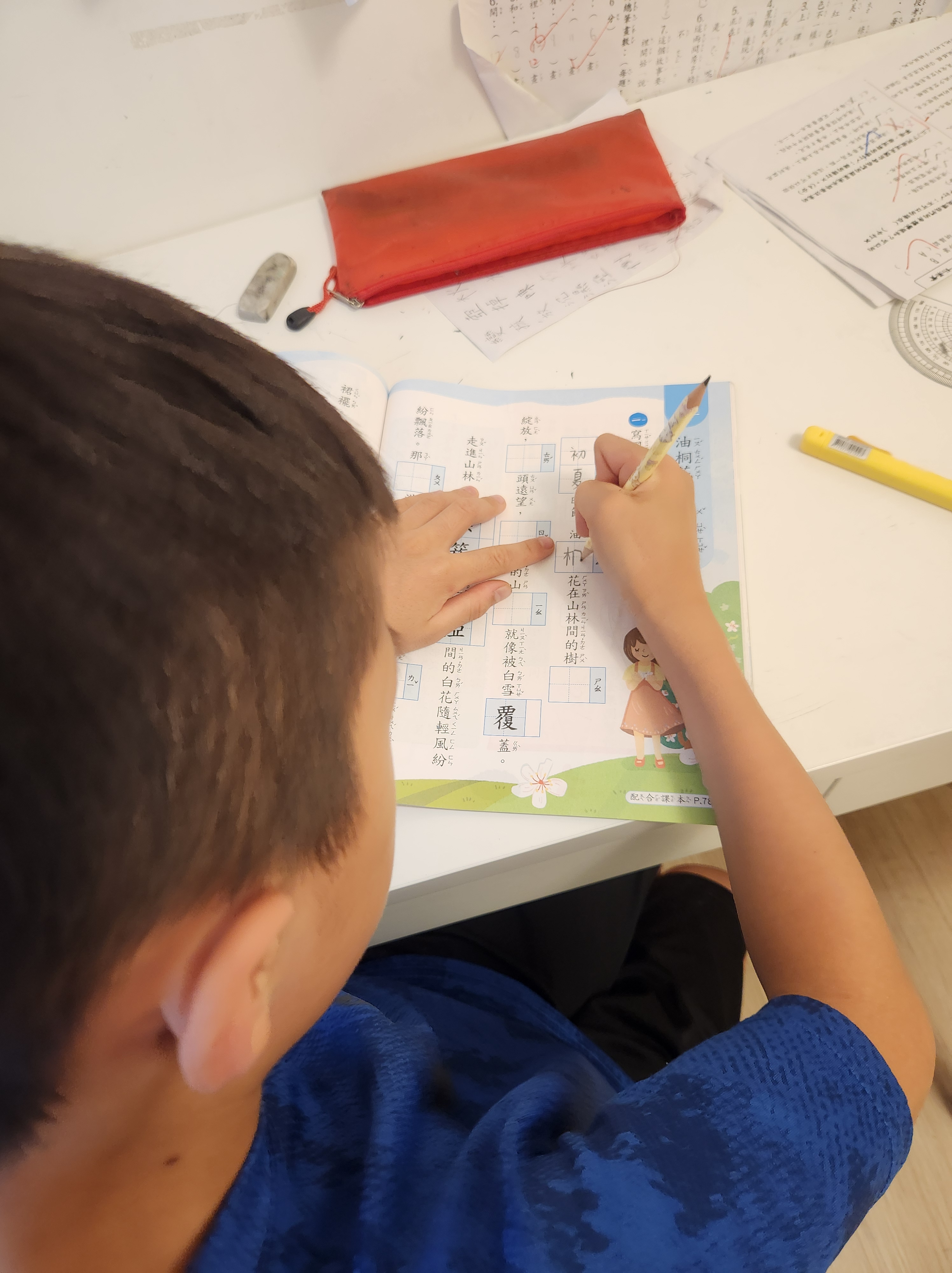
C’s homework is a lot more challenging, but he can often complete more than half of his assignments by himself. (The rest is with his tutor’s help.) The fact is he is able to read, understand and answer difficult problems in Chinese is already a huge improvement from nine months ago. What I’ve noticed about C is that he’s able to retain information better as well. Almost every week, there is a dictation test on new vocabulary at school. At the beginning of the school year, I would help him study and man, it was a struggle! He would maybe get 20% right on the first try. Now, we wouldn’t really need to practice and C would still get almost every word correct.
This is why an immersive environment is so helpful when learning a language. In the US, both boys were SO resistant to doing anything in Chinese because it wasn’t the norm. Family and friends there all spoke English. Here, their friends speak only Chinese. Their teachers speak only Chinese. Everywhere they go, people speak only Chinese. If they want to watch TV, it will be in Chinese because there’s no other option. In this sink or swim environment, they learned they had to swim.

It’s been amazing witnessing C and O’s progress. I love hearing them talk in Chinese; it’s like reliving the time when they were toddlers first learning how to speak. As much as I am amazed at how quickly they’re learning, I am also incredibly proud of their attitude. They never once complained about not understanding anything, or all the homework and tests at school. They never seem frustrated when they have to read an entire page of Chinese, or have to write pages and pages of characters.

C and O are not fluent (I think my Chinese is still better than theirs 😅) and I honestly don’t expect them to be. But what I hope they’ll extract from this experience is that they can learn and do anything with patience and grit.
Ramblings

Learning Chinese: 1 Step Forward, 2 Steps Back

This post only pertains to my Chinese learning journey. I’ll write about the boys’ progress in another post.

We’ve been living in Taiwan for 9 months already 🤯, and for the most part we’ve adjusted to the Taiwanese way of life. We’ve made friends, are comfortable navigating around the city, and have our daily routines nailed down.

The biggest challenge has been, and continues to be, learning Chinese. I wrote about first learning Chinese 6 months ago, and while my Chinese has improved drastically since then, I feel like it’s plateaued. I can comfortably order at a restaurant, exchange simple pleasantries with strangers, and introduce my background. But beyond that, it can be a struggle holding conversations.

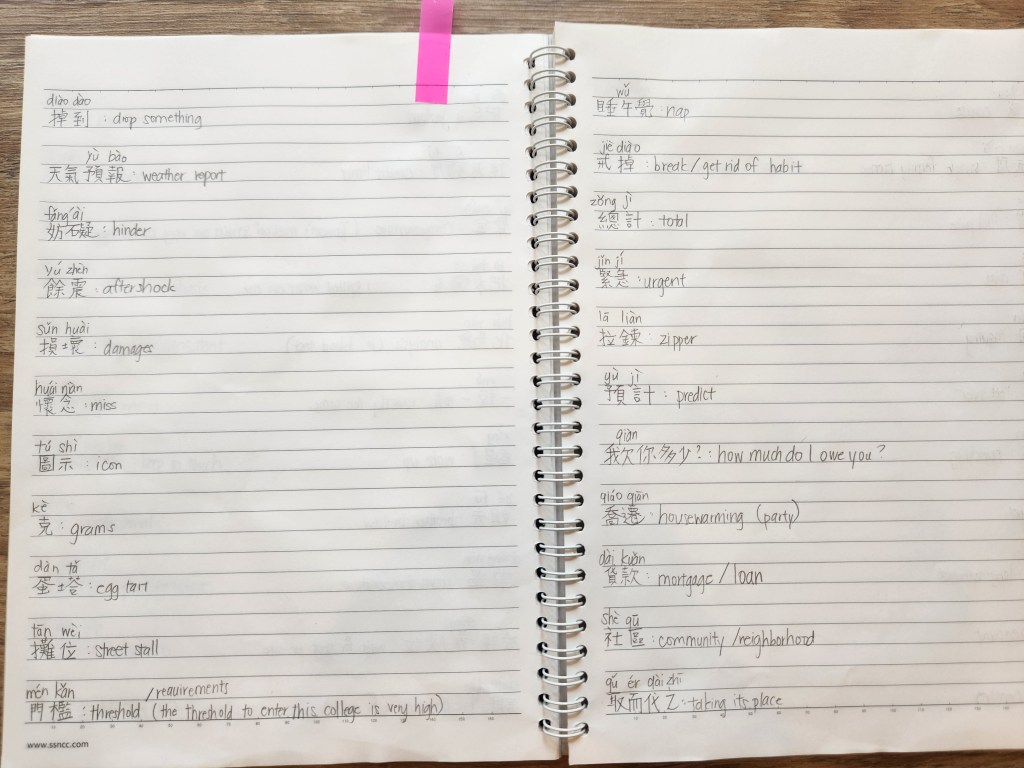
My conversation skills are completely dependent on the topic. I can chat about the kids’ school and about daily life, but if the topic shifts to say, skincare, I am clueless. (This actually happened in real life: I went in for a facial and had zero clue what the aesthetician was telling me about my pores and moisturizing. 😅) This is because I have been learning vocabulary by subject matter. I write down words that are useful or related to a topic that interests me. For example, after the earthquake, I learned the Chinese words for “damages”, “aftershock”, and “predict”, knowing that this subject might come up.

My notebook of Chinese words. I’m already on my second book!

So on days when I’m chatting about kids or eating out, I feel pretty good about my Chinese. Other days – like today, when a sales person tried to introduce me to different types of sneakers- I feel like I took 2 steps back.

All is not lost though. Because I have been writing down words and reviewing them consistently, my reading and writing skills have improved a lot. I can read signs and simple text messages without having to copy and paste into Google translate. I can write messages using pinyin (though it still takes me awhile to do). An indirect effect to all this is that my mom even noticed that my Cantonese got better! 😊

Aside from learning vocabulary words, I have been listening to podcasts, meeting language exchange partners and doing weekly sessions on italki. (I’ll list these resources at the bottom of this post.) I still volunteer at the boys’ school and it’s a great way to chat with locals, but our conversations are usually pretty perfunctory. I stopped taking in-person Chinese classes after the boys’ winter break. The classes gave me a great head start, but I wanted to try other things.

Baba asked me what my next goals for Chinese are, and honestly I’m not sure. To feel confident enough to just speak without mulling over every word? To be able to have deeper conversations with people? I don’t really have a definitive, measurable goal other than continuing to improve. It’s hard, but to be able to connect with people using their language is an amazing feeling.

Resources for Chinese Language Learning:

  • Learn Taiwanese Mandarin podcast – Probably my favorite podcast so far. The best part is she has a website with transcripts of each episode that includes pinyin and the English definitions.
  • Talk Taiwanese Mandarin with Abby podcast – Another good podcast for Chinese learning. You do have to join her Patreon to access the transcripts.
  • italki – An online language platform where you can schedule 1:1 video chats with teachers. It’s convenient – you can schedule classes according to your schedule – but classes can be expensive. I found a teacher I really like on there.
  • Tandem – A free language exchange app where you can find people to chat with. (Conversely, I’d help them with English.) I’ve met a couple of people through the app, but the problem is finding someone who can regularly practice with you.
Ramblings

Learning Chinese

This shit’s hard.

One of the reasons we chose to live in Taiwan is because its national language is something other than English. Moreover, we wanted to learn a language that is going to be interesting and useful to us, and Mandarin Chinese was perfect.

Baba and I are ethnically Chinese, though I grew up speaking Cantonese and learned Mandarin in high school and college. Baba grew up speaking Chiu Chou, and also studied Mandarin in high school. But that was ~20 years ago and most of what we learned has been forgotten.

So there’s really no better way to re-learn Mandarin than to live in Taiwan, right?! Except compared to ~20 years ago, our middle-aged brains can’t learn fast enough. I go to Chinese class twice a week for 4 hours at a place called LingoLab in Da’an. I come out of each class thinking my Mandarin is pretty decent, but then I get a reality check when a 7-11 clerk asks me a question other than “do you want a receipt?”. Ugh.

Classes at LingoLab are small (there is only 1 other student in my class), focus mostly on spoken Chinese, and cater to busy foreigners. Tuition is also reasonable. National Taiwan Normal University is actually the gold standard for foreigners learning Chinese in Taipei, but the courses are like 15-hours a week on top of many written exams. I just didn’t want to make that commitment.

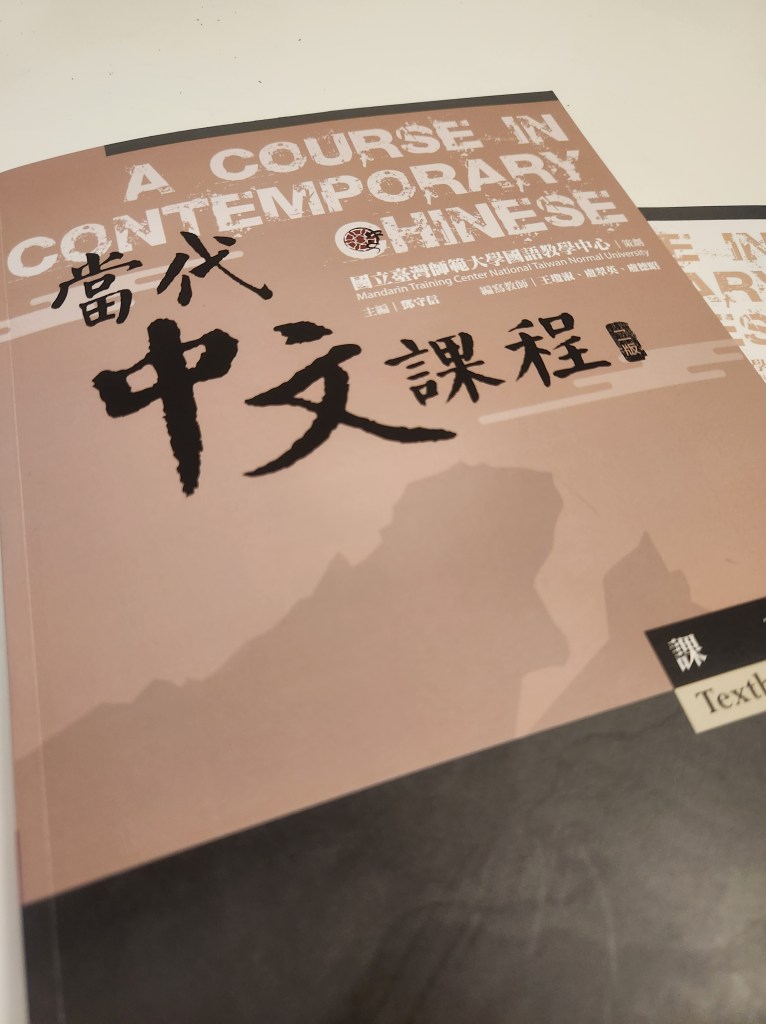
The textbook I use for class, published by the NTNU. It teaches Taiwanese Mandarin, and the lessons are really useful for daily life. There are also accompanying audio recordings on YouTube.

Because I have a foundation in Cantonese, I can understand quite a bit of Mandarin. My biggest obstacle is my limited vocabulary and due to that, a lack of confidence when speaking. It can be frustrating sometimes because I actually have a lot to say! 😆 But I don’t know how to express myself and so I slink away feeling defeated and embarrassed.

Baba self-studies at home for about 3 hours a day through a site called huayuworld.org. The site includes a lot of great resources to learn Chinese. Baba never kept up with any Chinese back home so he has to start from scratch. But to his advantage, he isn’t afraid to strike up a conversation with anyone, even in his broken Chinese (which is similar to C’s personality).

There are days when we feel like we’re making progress, and other days when we feel like we’re still so, so far behind. Despite all this, I still find learning Chinese interesting and enjoy the challenge. So, I’m setting small goals for myself: maybe it’s to confidently order a meal at a restaurant (which I think I’ve gotten 80% of it down now) or maybe it’s to ask more questions when shopping. But however slowly, I believe we’ll all get there one day!

Other useful Chinese online resources:

Ramblings

School Prep

Isn’t it funny that as children, we’d kick and scream bloody murder when our parents made us learn Chinese but now that we’re parents, we’re doing the same to our kids? We know the Chinese in Taiwan will be a gazillion times harder than what we ever learned here, so we’re trying our best to prepare the boys.

We started them with online Chinese classes during the pandemic. When school opened back up, we enrolled them in the after school Chinese program. The actual language instruction time isn’t much; it was 30 minutes each week for the online classes, and 1-2 hours each day in the after school program.

Another challenge is that the Chinese taught here is mostly Chinese Mandarin and not Taiwanese Mandarin. While the two languages are very similar, Chinese Mandarin uses simplified characters and Taiwan uses traditional. Chinese Mandarin also uses pinyin while Taiwan uses bopomofo, or zhuyin. The boys have been learning Chinese Mandarin at school.

Knowing bopomofo is critical if you attend school in Taiwan. It’s the Taiwanese alphabet phonetic system, so it’s like Americans having to know their ABC’s. Even though my Chinese is limited, I knew I had to at least teach C and O bopomofo.

I first purchased a cute set of bopomofo flashcards on Etsy. Learning 4-5 alphabets a day, I taught myself bopomofo before teaching the boys. They picked it up within 3 weeks.

But the challenge was (and still is) reading bopomofo when the alphabets are strung together. It’s one thing to know your ABCs, but it’s another endeavor to know how to read. On top of this, there are the 5 tones in Chinese which the boys yet have to master.

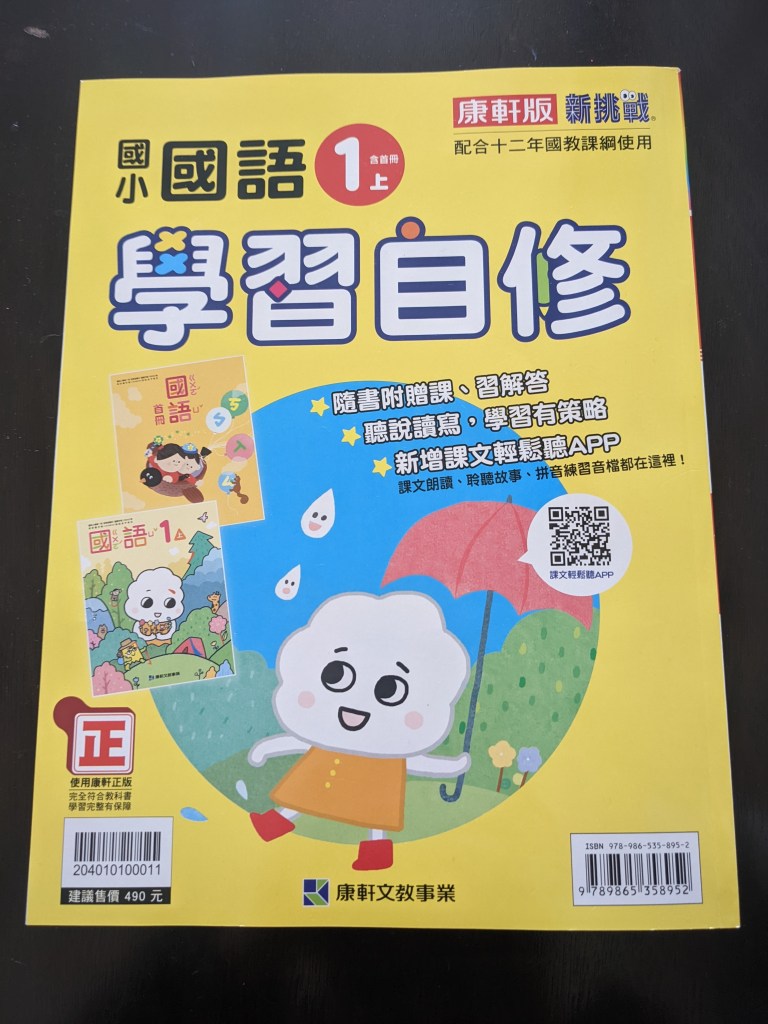
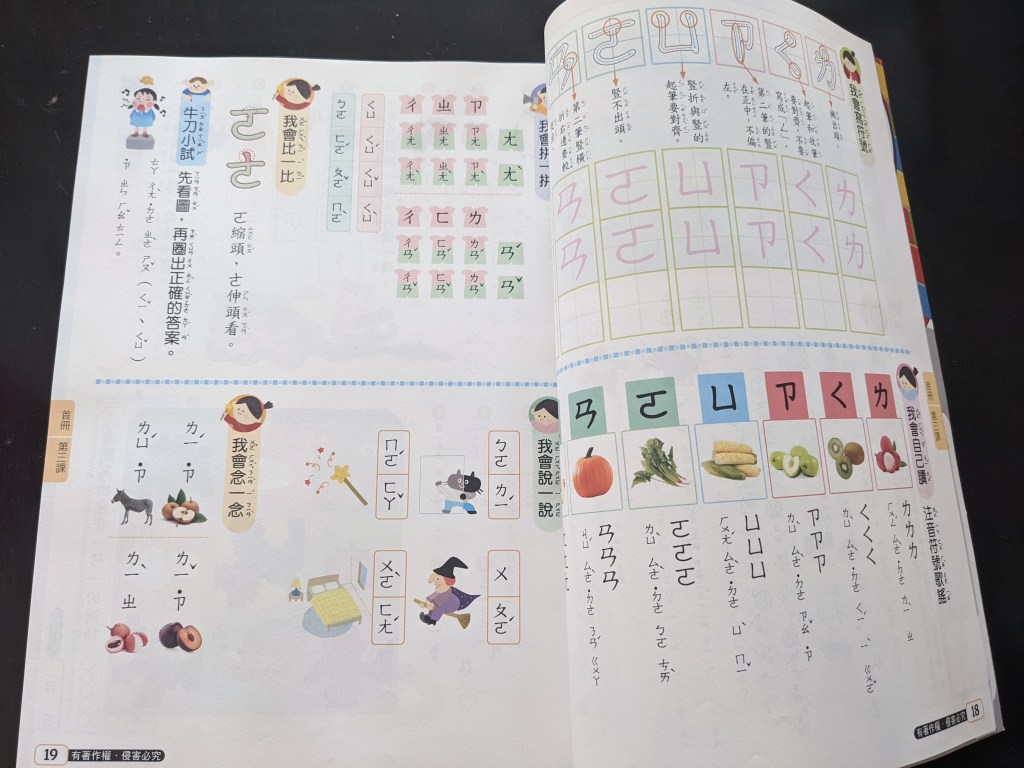
A mom living in Taiwan suggested that I buy a grade 1 textbook to see what the curriculum is like. I purchased a self-study textbook from Kang Xuan, one of Taiwan’s main textbook publishers. The book itself was cheap (~$13 USD) but combine that with international shipping and it came out to $45. What made things worse was that I accidentally bought two copies (d’oh!) because I thought the company cancelled my order. I was eventually able to sell the second copy but at a loss. So my copy of the textbook was actually more like $65, eek.

Unsurprisingly, grade 1 Taiwanese Chinese is pretty damn hard. The first section is purely bopomofo. The boys and I have been trying to do a little each night, but it’s daunting. Even though we can read the bopomofo, there are times we don’t understand what we’re reading.

I much prefer pinyin because it uses Roman alphabets, which is more natural for us to read. With bopomofo, it takes more effort for me to convert the alphabet into the right sounds in my head.

The remaining sections in the textbook are all in Chinese. This is definitely not the same as 1st grade Chinese here in the US, where students are likely learning simple words like 吃飯, 說話, 前面. The textbook uses complex vocabulary and phrases (at least to me they are!). It’s expected because these books are for native Mandarin speakers – it’s just more worrisome for us.

In hindsight, buying the textbook wasn’t the best idea. It’s hard for even me to digest, so how could I use it to teach the boys? I should’ve listened to my parents and learned Chinese when I had the opportunity. Sorry Mom!

Later, I found a free resource with PDF textbooks geared towards Chinese learners. The books have English instructions, with both pinyin and bopomofo. The exercises are a slow and easy ramp up, much more manageable for beginners.

Baba thinks our efforts are futile. The boys will struggle in school no matter what, and I don’t doubt that. In a highly competitive and test-centric school culture like Taiwan, we’ll have to emphasize to the boys that they are doing this for the experience. It doesn’t matter what their grades are. What matters to us is that they remain open-minded, make new friends and absorb as much of the language and culture as they can.

I just hope they’ll remember this when they’re crying over 4 hours of homework each day 😅.