C and O have been back in school for over a month now, so I thought it’d be a good time to share a little recap. I’ll start with big brother C (哥哥) first.
In Taiwan, elementary students switch teachers and classmates every two years, a transition that can feel nerve-wracking for families. This year, both C and O had to change classes. Knowing this, Baba and I met with the Director of Academic Affairs to request a more “relaxed” teacher for C. Since he was already doing about 2 hours of homework in 4th grade everyday, we couldn’t imagine what it would be like for the next two years.
The Director assured us that teachers are randomly assigned (which we weren’t entirely convinced of but let go) and said we’d need to work directly with C’s teacher. In August, classroom assignments were released and C was placed with the most notoriously strict 5th-grade teacher 😆. And we knew she was strict because she mailed every family a 4-page letter outlining expectations and sent daily reminders all summer.
We reached out to the teacher share our situation. She asked if C could try completing all the homework for a month and then see if adjustments are needed. We replied that he will do the best he can within the time we allocated for him (~1 hour a day), with the condition that he wouldn’t have to stay in class during recess if he couldn’t finish (a common practice here).
I was nervous about how she’d respond. In Taiwan, homework and tests are the ultimate measures of success, and this teacher seemed stern and unyielding. But to my surprise, she’s been understanding. Even when C couldn’t finish his homework, she didn’t scold or embarrass him (though she still has to grade him fairly). Over time, C has grown to appreciate that she allows students to start homework in class, has a structured schedule, and even her humor while scolding students. I’m grateful he’s kept such a positive attitude through all these changes.
Left photo: C doing homework in class. Right photo: His nightly stack of homework books. 😯
This year has been a bit more challenging since we decided not to bring back our tutor. Combined with our limited schedule for C’s Chinese homework, it’s led to lower grades, which was something we expected. We keep reminding C that this choice is intentional: we want to prioritize his well-being and focus on what will benefit him in the long run. Of course, once we’re back in the US, homework can’t be left unfinished and grades matter more. I just hope he’s not going to think that skipping work or poor grades are acceptable… 😣
For extracurriculars, C is on the badminton team, Global Scholars Program, and an ambassador 小小外交 at school. He also had the opportunity to visit Kinmen 金門 (an outer island of Taiwan) for 3 days in September with classmates. Outside of school activities, C (and O) still practices Brazilian Jiu-Jitsu, has gotten really interested in Minecraft and making Lego stop motion videos. Baba has also been working with the boys on simple engineering projects, while I’ve been focusing on reading and writing. It’s been busy in a good way!
Oof. I haven’t had the motivation to write anything as of late. But with the school year is slipping away (less than 2 months to go!), I wanted to record our second-year experience at our school in Taiwan.
Students in elementary school have the same teacher, classmates, and schedule for two consecutive years, so there were no changes there. O is in 2nd grade, comes home at noon on most days, and homework is still about 20 minutes each day. This schedule is great because it allows him to relax and pursue his interests. For awhile he was into Rubik’s cube, and now he’s into reading (current favorite genre is fantasy) and coding.
Coding on Scratch.
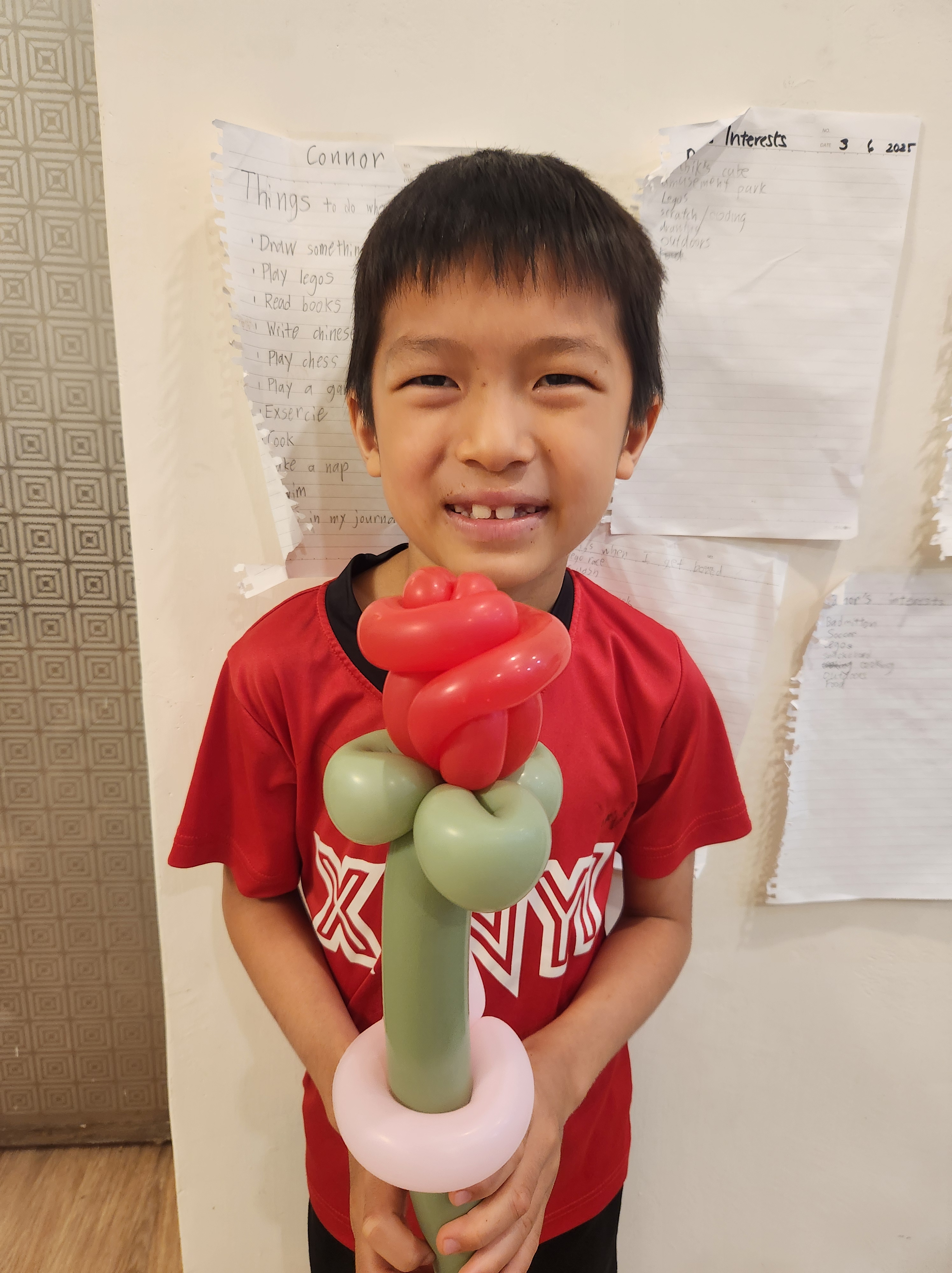
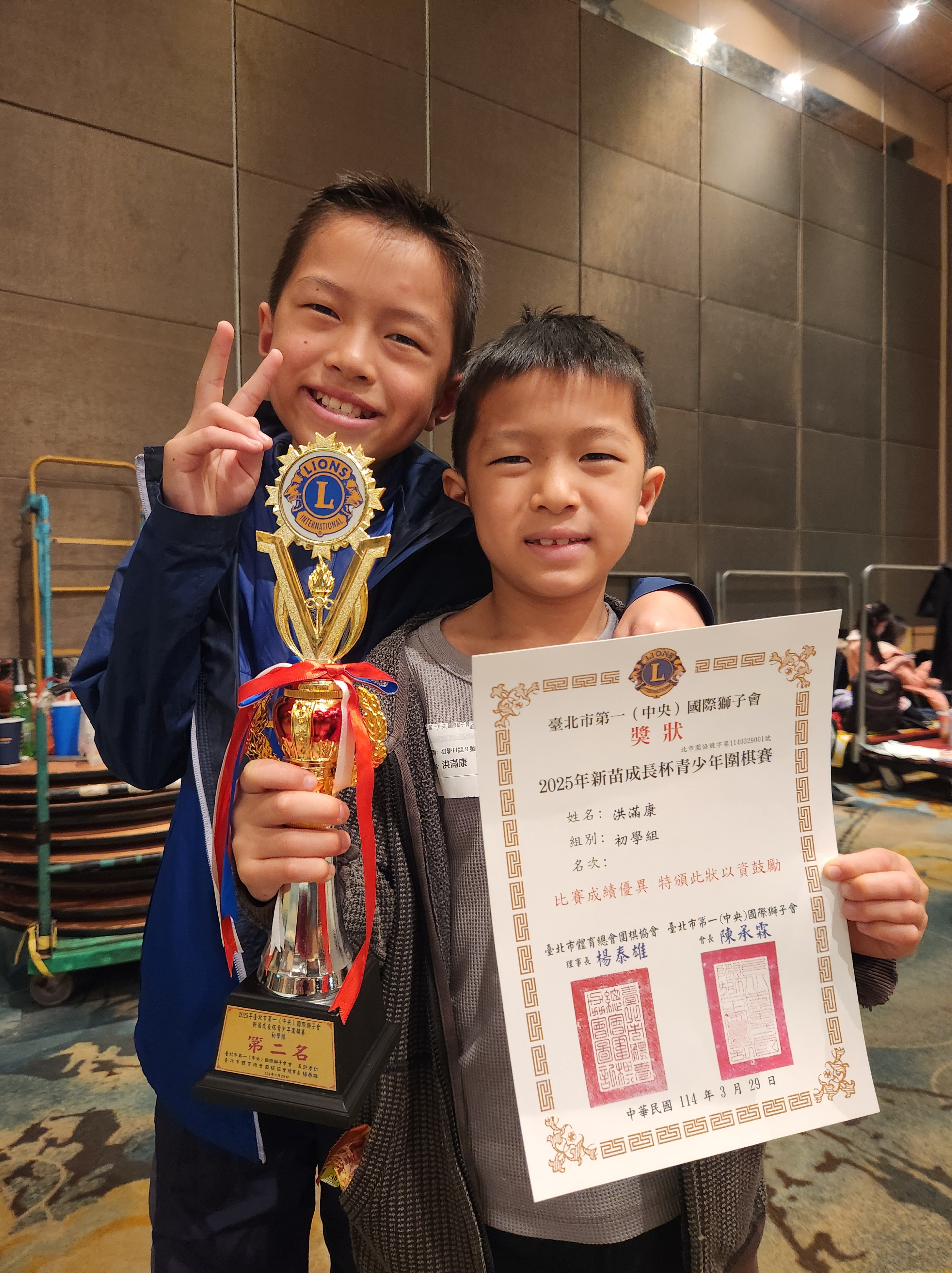
O also participates in a lot of after-school activities like swimming, Lego, balloon modeling, and Go 圍棋. He enjoys Go so much that we signed him up for a competition outside of school and he won 2nd place in the beginner’s group!
We’ve also been able to tutor O in English and math more at home due to his relaxed schedule. He is progressing a lot faster than C in this regard.
On the contrary, 4th grade for C has been filled with homework, homework and more homework. Even though he has the same teacher as last year, the volume and difficulty has increased. It also doesn’t help that 4th graders have school until 4pm on most days, and then C has badminton team practices and after-school activities until 5:45pm everyday. By the time he eats dinner, showers, and finishes homework, it’s already time to go to bed. C doesn’t have a lot of free time to relax and just be a kid. If this is what school is like in 4th grade, I’m nervous about what’s to come in 5th and 6th. 😬
Surprisingly, C hasn’t complained much about the long hours of Chinese homework—or even when Baba and I try to squeeze in extra math and English. I’m grateful he’s so diligent, but we still wrestle with how to balance the endless grind of schoolwork with simply letting him be a kid.
We’ve had to postpone projects because he’s busy all the time. Most weeknights, there’s no time for reading or playing because he’s doing homework right up until bedtime. And when he does get a sliver of free time, I feel guilty asking him to do more. Sometimes, people just need the space to switch off.
We’ve considered working with his teacher to reduce homework, but C didn’t want to. He wants to complete every assignment, and do it as well as he possibly can. (Honestly, he spends more time than necessary perfecting every stroke and sentence!) And so we find ourselves stuck again: we don’t want to temper C’s desire to excel, but we also want to make sure he doesn’t burn himself out.
Going to school in Taiwan has undoubtedly been a life-changing experience for the boys, but sometimes I can’t help but wonder how much more carefree their lives might have been if we had stayed in the U.S. No homework, no midterms and finals, just free time to explore. In the end, we’re still trying to strike that everyday balance between homework and happiness.
We’ve been at a public elementary school in Taiwan for almost a month now. Our experience has been interesting, surprising, and eye-opening. I wanted to share some similarities and differences I’ve noticed between Taiwan schools and US schools.
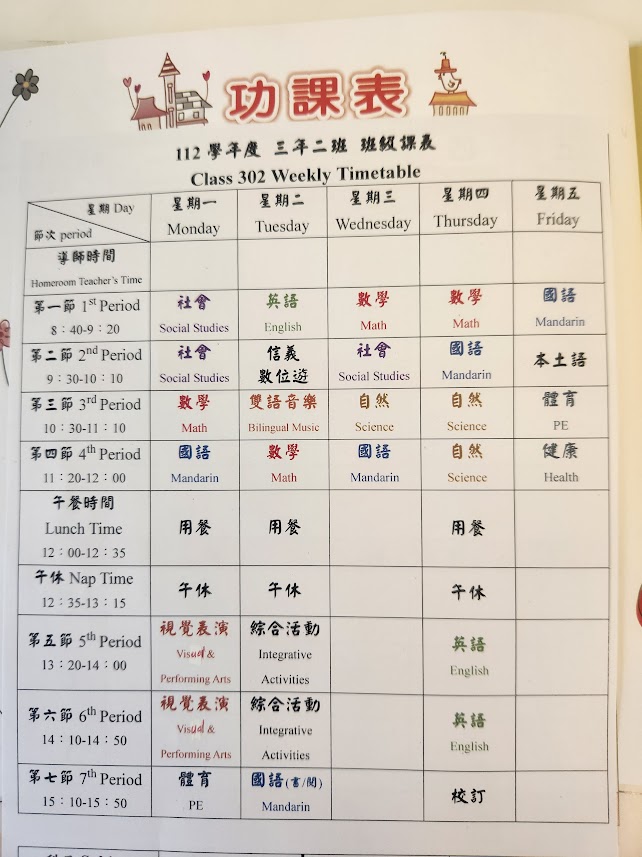
Class Schedule. Students study pretty much the same subjects as in the US. There is math, PE, science, English, music and language arts (except we’re learning Chinese Mandarin of course). However, elementary students in Taiwan follow a period schedule, much like middle school and high school in the US. There is homeroom, followed by periods for the different classes. The homeroom teacher is the “main” teacher for subjects like math and language arts, but kids change teachers and classrooms for the other classes. Kids also have a textbook and workbook for each subject – totaling to about 15 books! 😮
Students at different grades also have different schedules. C, who is a 3rd grader, has three long days during the week, in which his classes go from 7:50am – 3:50pm. O, a 1st grader, only has one long day during the week. The rest of the days are short days, from 7:50am – 12pm. We had a hard time trying to remember their schedules at first!
Homework. Like in the US, there is homework and it’s usually on math and language arts. There is homework everyday, even on weekends. We were prepared for 2-3 hours of homework a day, but so far it hasn’t been that bad. O’s homework is really easy right now, because he’s still learning the basics of zhuyin. The math is just counting or very simple addition. He usually completes everything within 20 minutes.
C’s homework is more complicated solely because the questions are all in Chinese. But in terms of quantity, it’s manageable. I’d say his homework takes anywhere from 1-2 hours a day. If he could read/write Chinese fluently, I’m sure it would be half the time. We also lucked out finding a great tutor who comes to our place everyday for an hour to help him with homework. Otherwise, we would be struggling with Google Translate. 😅
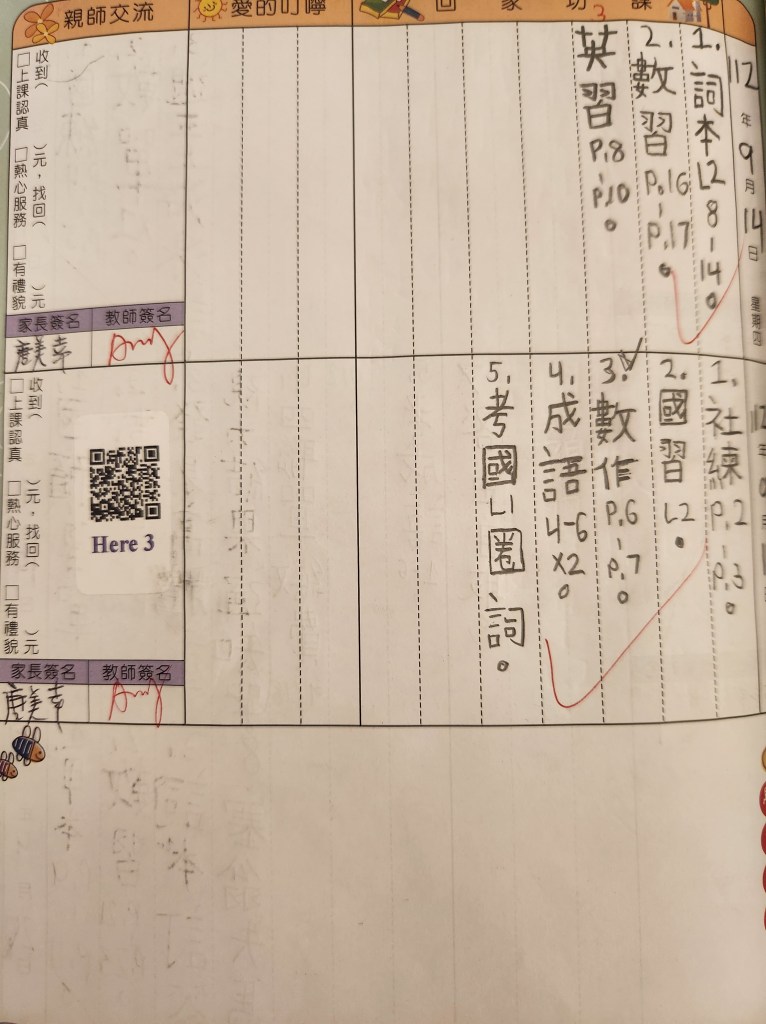
Daily homework assignments are written in a booklet. The teachers review and make sure students wrote everything down correctly. Parents then have to sign it each night when the homework is completed. You can also write messages to the teacher in the booklet, but most communications are done via LINE.
Recess (or lack thereof). Schools in Taiwan mostly have 10 minute breaks in between classes. The longest break is 20 minutes. Unlike the US, students don’t have an official “recess” where they go out into the yard and play. They usually either hang out in the hallways or stay inside the classroom. They get a 40 minute nap time after lunch, but that just means they rest their head on their desk inside the classroom. At first, the boys were disappointed there was no recess and I was worried they weren’t getting enough outside time. But like with everything else, they’ve gotten used to it and don’t mind it at all now!
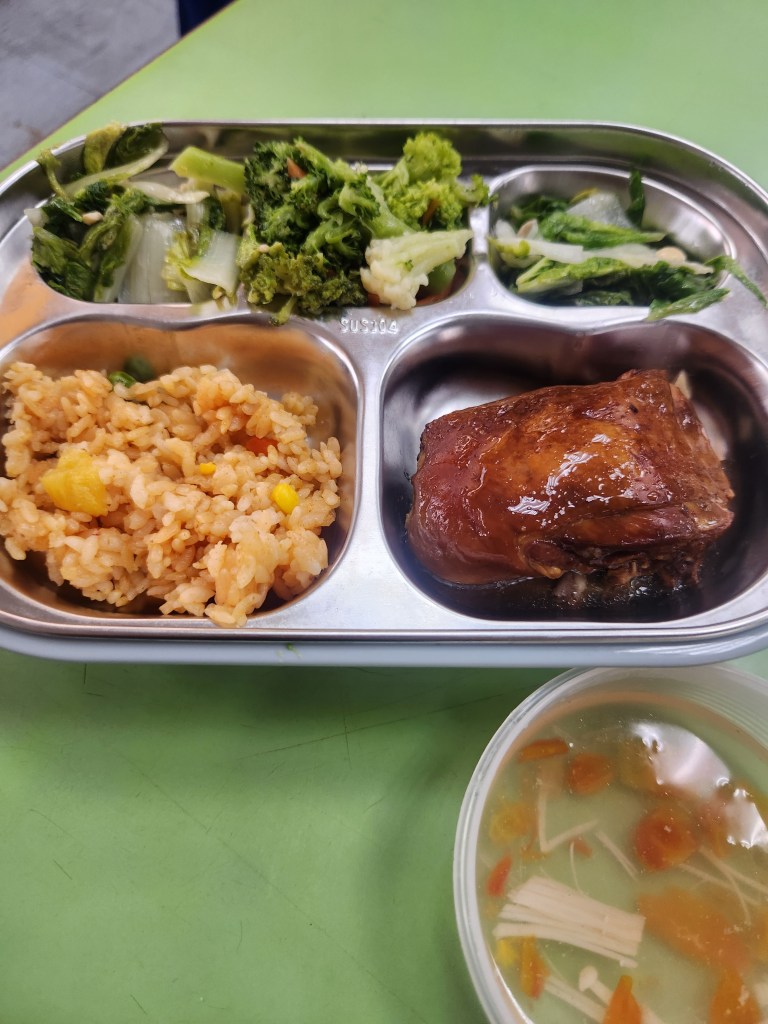
Lunches. The school provides lunches, but only on long days. The lunches are served and eaten in the classroom because there is no cafeteria, and students have to bring their own utensils. The boys have been loving the food, and look forward to it. Lunches usually consist of a rice, protein, vegetables, soup and fruit, and they try to serve different types of cuisines. The boys say it’s “SOOO MUCH BETTER” than the school lunches in the US. 😆 What’s also interesting is that students have to brush their teeth after lunch too!
PTA. Back at our old school in SF, Baba and I were pretty involved with the PTA. It was a great opportunity to help out the school while getting a glimpse into our kids’ day. I didn’t expect schools in Taiwan to have anything like that, but it turns out our school has a “Parent Association” or 家長會. Currently, Baba volunteers as a traffic control guard and I volunteer at the library.
Parents take volunteering seriously here! When you sign up for shift, you are expected to show up that day/time for the entire semester. (Unlike the US, where parent volunteers come and go whenever they please.) Baba had to undergo training for his job and the 家長會 had to buy him insurance. There are also group chats for each volunteer team, and there are multiple messages being sent everyday!
School Fees. In the US, public schools are entirely free (unless you join special clubs, teams or what not.) In Taiwan public school, there are fees. We have to pay for textbooks, school lunches, and bring all supplies. This includes pencils, markers, scissors, glue, and so on. It’s not expensive – we paid less than $200 per kid this semester – but it was a little surprising coming from the US.
However, what’s different in Taiwan is that there are zero school fundraisers. Everything is “paid for” in US schools because families raise funds to support the classrooms. Here, families are responsible for their own expenses. Neither is good or bad, just different!
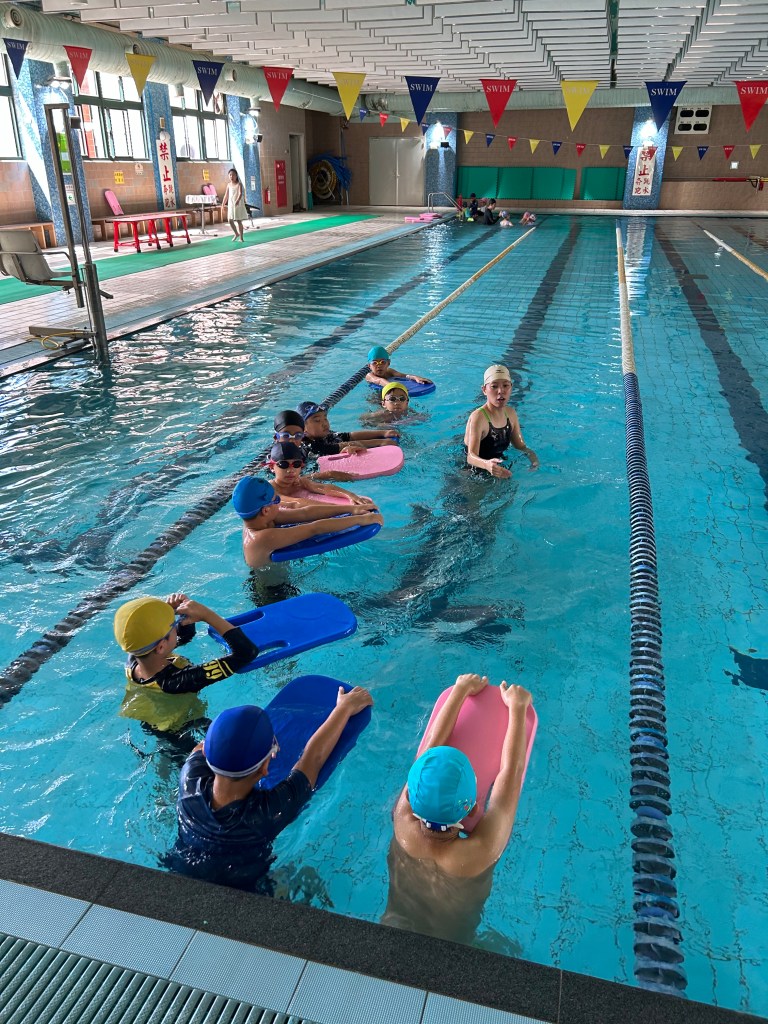
Swim Class. Something really interesting at our school is that it has a pool! Many schools in Taiwan have a pool too, but not all. Students at our school take a 4-week swim class during the semester. I can’t imagine the logistics of trying to get 25 kids in and out of the pool, but I guess the school has figured it out. Kids are grouped by swimming ability. We don’t expect the boys to come out of the class being pro swimmers, but it’s neat that the school has this option.
Afterschool Care. Taiwan schools have afterschool care too, where kids can get homework help. But we felt like C needed 1:1 help in Chinese, so we opted out of this program. However, we were surprised to learn that our school offers A TON of after school activities. There is in-line skating, badminton, ping-pong, magic, track & field, Legos, taekwondo, and much more! We got a little too excited and signed the boys up for something everyday. 😅
But much like the school fees, there are costs to these activities and you have to supply all materials. So we had to purchase in-line skates and helmets, ping-pong paddles and even a deck of cards for O’s magic class.
School Teams. Back in SF, our school had one sports team (soccer) and that was 100% run by parents. Here, our school has several school-run sports teams: basketball, swimming, soccer, badminton, track & field and even theater. But unlike the US, where all kids are accepted into the team (at least in elementary school), there are tryouts here. Not everyone gets in. C says he wants to try out for track & field next semester, so we’ll see.
As I’m writing this post, I realized there are other differences between the schools in the US vs. Taiwan that I haven’t mentioned. Not glaringly different as the ones I’ve listed above, but still interesting. This post is getting too long though, so hopefully I can get to it next time!





 Hongs Abroad