In my last post, I shared the differences between public schools in Taiwan vs. the US. After some thought, I realized there are more differences I wanted to share.
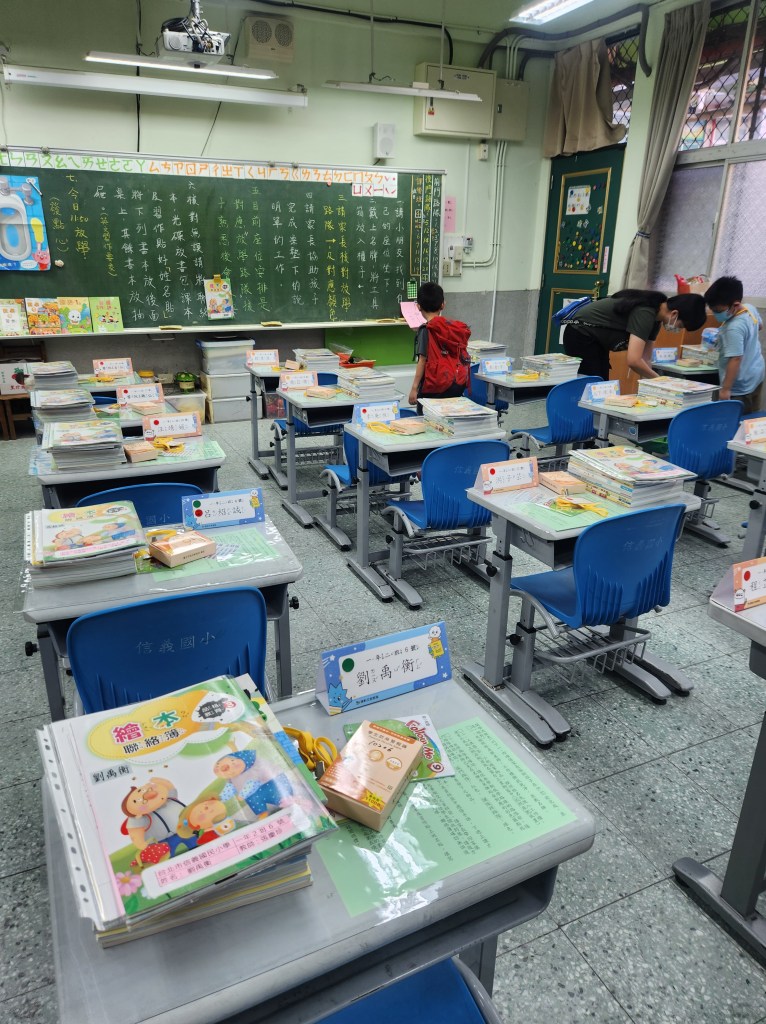
Classroom Setting. In the US, elementary school classrooms are usually pretty colorful and cheery, with artwork on the walls and bright rugs for circle time. Kids’ desks are usually pushed in groups to encourage teamwork. In Taiwan, the classrooms are not as cozy. There are rows of individual desks (though some classes may have two desks pushed together) and the rooms are bare except for teaching materials. There are no games, artwork, toys or books. Honestly, this brought back terrible memories of Chinese school for me. 😬
Tests, Tests, Tests. I knew beforehand that Taiwan schools are very focused on tests. What I didn’t know is how many there would be! O, even in first grade, has dictation tests each week. C either has a dictation or math test each week. There are also midterms and finals, and from what I understand, students are ranked at the end of each semester. 😬 In the US, there aren’t tests until the third grade. Even then, it’s just one exam taken on the computer.
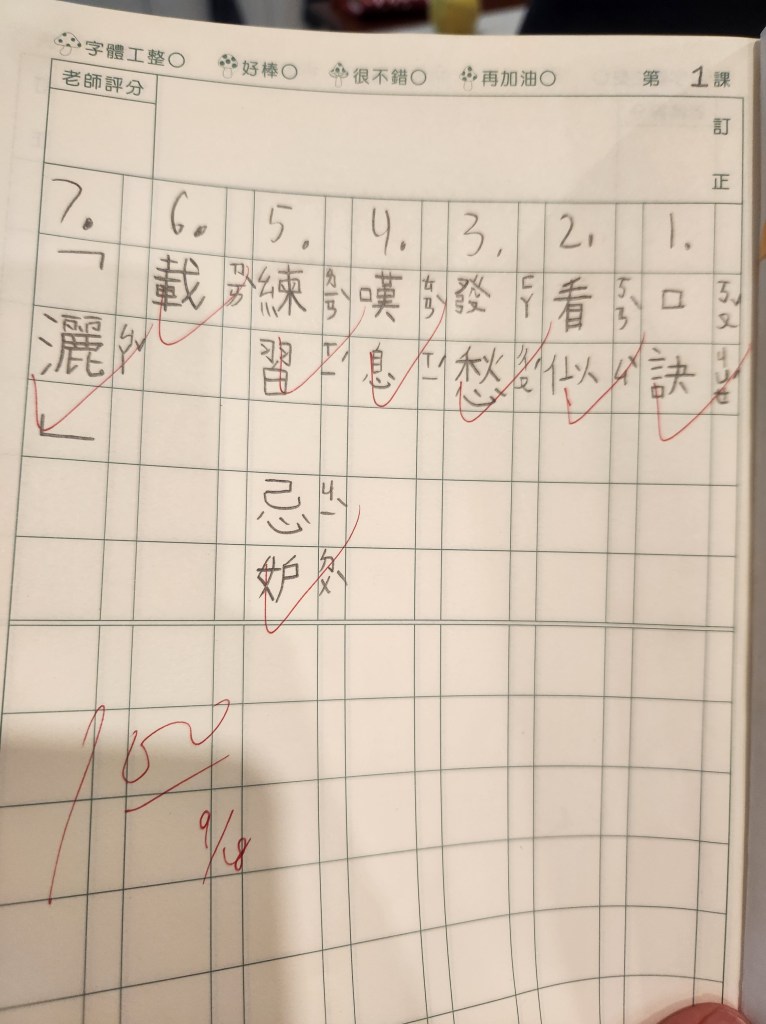
Grades. Elementary school in the US do not use real grades. Teachers use a rating system from 1-4, 4 being exceeding grade level. Homework assignments are given either a ✔+ or ✔. Here in Taiwan, everything is graded. You get one stroke or phonetic symbol wrong, points will be deducted. Parents also have to sign off on the test results. Below is C’s first dictation exam but he’s had others that were not so ideal.
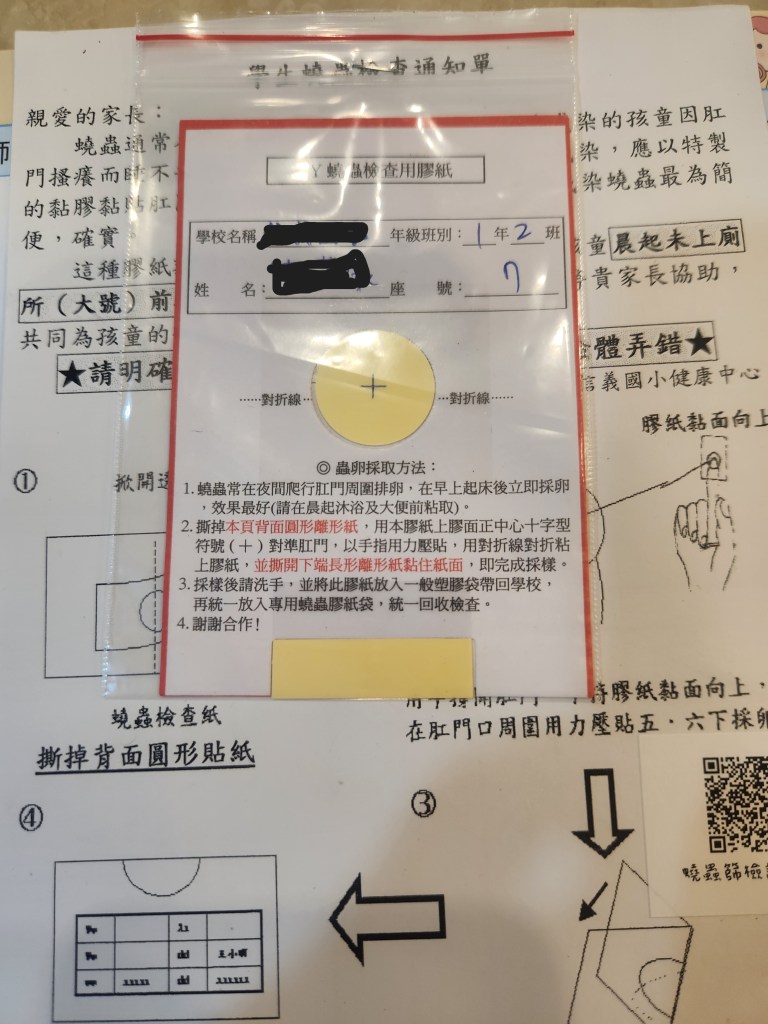
Health Tests. Besides academic tests, there are health tests that are administered at the school. So far, only O had to do the tests, so maybe they’re only for first graders. These tests require getting a sample at home. We’ve had to provide a urine sample and more recently, do a pinworm test which required getting a sample from where the sun don’t shine. 😂 I also read that students get a dental exam later on in the year. I can’t imagine US schools implementing something like this.
Staff. You often hear schools being short staffed in the US. I was surprised to see so many staff at our school in Taiwan! (Then again, our school has 700-800 students so they do need the manpower.) There is a Department of Academic Affairs, Department of General Affairs, Department of Student Affairs, and so on. Each department has a lead and then 4-5 staff. Then there are teachers for each subject. I remember at our old school in SF, we had one secretary who basically managed everything.
Saturday School. Last Saturday, the boys had school. This was a “make up” day for an upcoming Monday holiday. In Taiwan, if a holiday falls on Tuesday or Thursday, the government will give you Monday or Friday off to make it a 4-day weekend. But, you have to make up that extra day off by going to school or work on a Saturday. And yes, there is homework that day too. Again, file this under “things that will never work in the US.” 😂 There would be protests and riots, but the Taiwanese have such a strong work ethic!
We’ve been at a public elementary school in Taiwan for almost a month now. Our experience has been interesting, surprising, and eye-opening. I wanted to share some similarities and differences I’ve noticed between Taiwan schools and US schools.
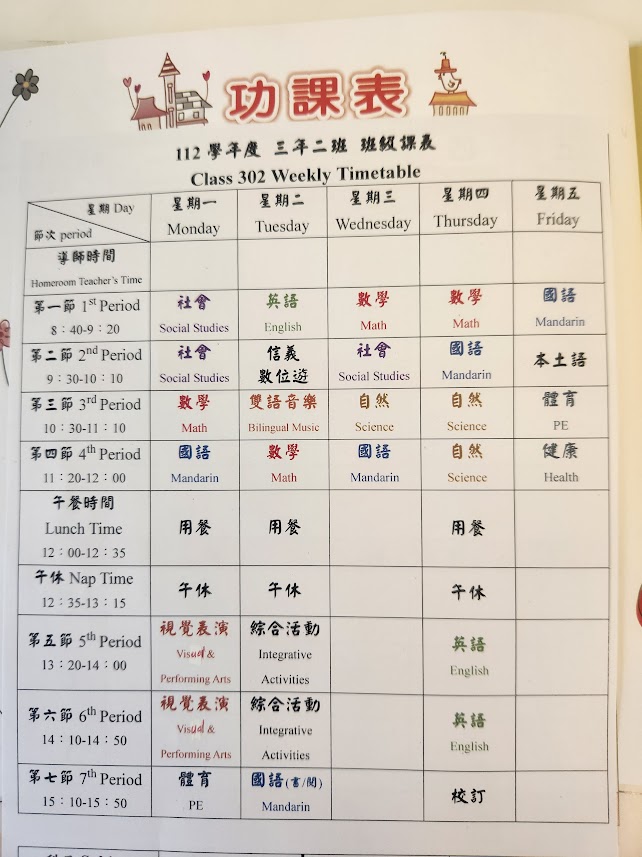
Class Schedule. Students study pretty much the same subjects as in the US. There is math, PE, science, English, music and language arts (except we’re learning Chinese Mandarin of course). However, elementary students in Taiwan follow a period schedule, much like middle school and high school in the US. There is homeroom, followed by periods for the different classes. The homeroom teacher is the “main” teacher for subjects like math and language arts, but kids change teachers and classrooms for the other classes. Kids also have a textbook and workbook for each subject – totaling to about 15 books! 😮
Students at different grades also have different schedules. C, who is a 3rd grader, has three long days during the week, in which his classes go from 7:50am – 3:50pm. O, a 1st grader, only has one long day during the week. The rest of the days are short days, from 7:50am – 12pm. We had a hard time trying to remember their schedules at first!
Homework. Like in the US, there is homework and it’s usually on math and language arts. There is homework everyday, even on weekends. We were prepared for 2-3 hours of homework a day, but so far it hasn’t been that bad. O’s homework is really easy right now, because he’s still learning the basics of zhuyin. The math is just counting or very simple addition. He usually completes everything within 20 minutes.
C’s homework is more complicated solely because the questions are all in Chinese. But in terms of quantity, it’s manageable. I’d say his homework takes anywhere from 1-2 hours a day. If he could read/write Chinese fluently, I’m sure it would be half the time. We also lucked out finding a great tutor who comes to our place everyday for an hour to help him with homework. Otherwise, we would be struggling with Google Translate. 😅
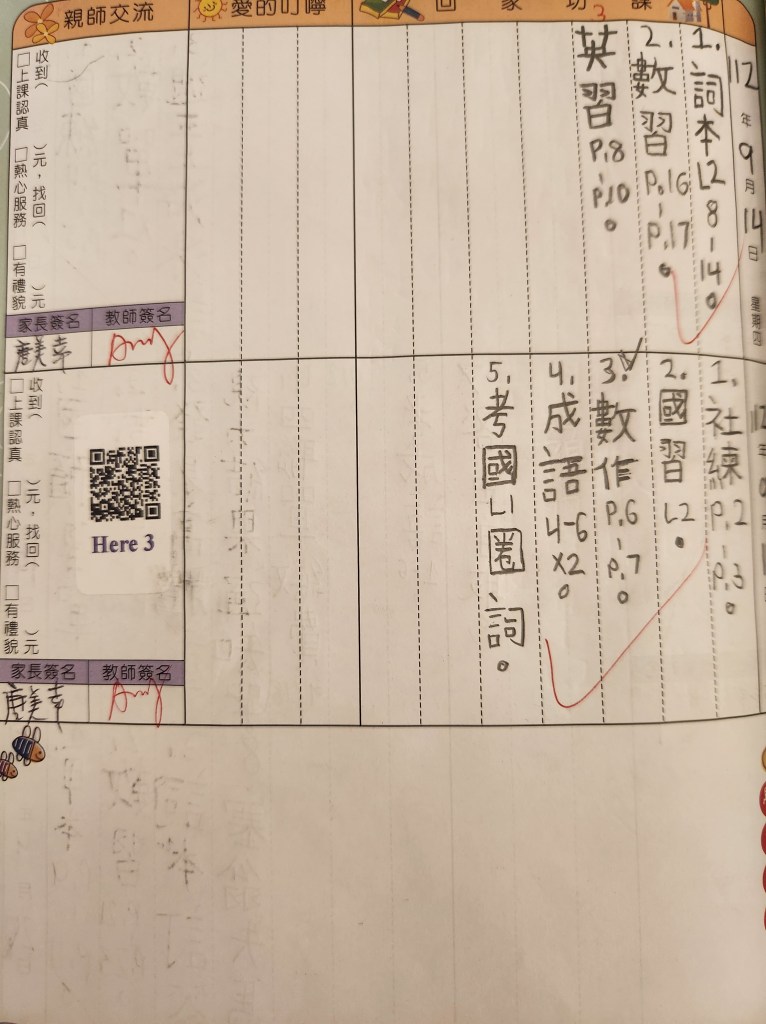
Daily homework assignments are written in a booklet. The teachers review and make sure students wrote everything down correctly. Parents then have to sign it each night when the homework is completed. You can also write messages to the teacher in the booklet, but most communications are done via LINE.
Recess (or lack thereof). Schools in Taiwan mostly have 10 minute breaks in between classes. The longest break is 20 minutes. Unlike the US, students don’t have an official “recess” where they go out into the yard and play. They usually either hang out in the hallways or stay inside the classroom. They get a 40 minute nap time after lunch, but that just means they rest their head on their desk inside the classroom. At first, the boys were disappointed there was no recess and I was worried they weren’t getting enough outside time. But like with everything else, they’ve gotten used to it and don’t mind it at all now!
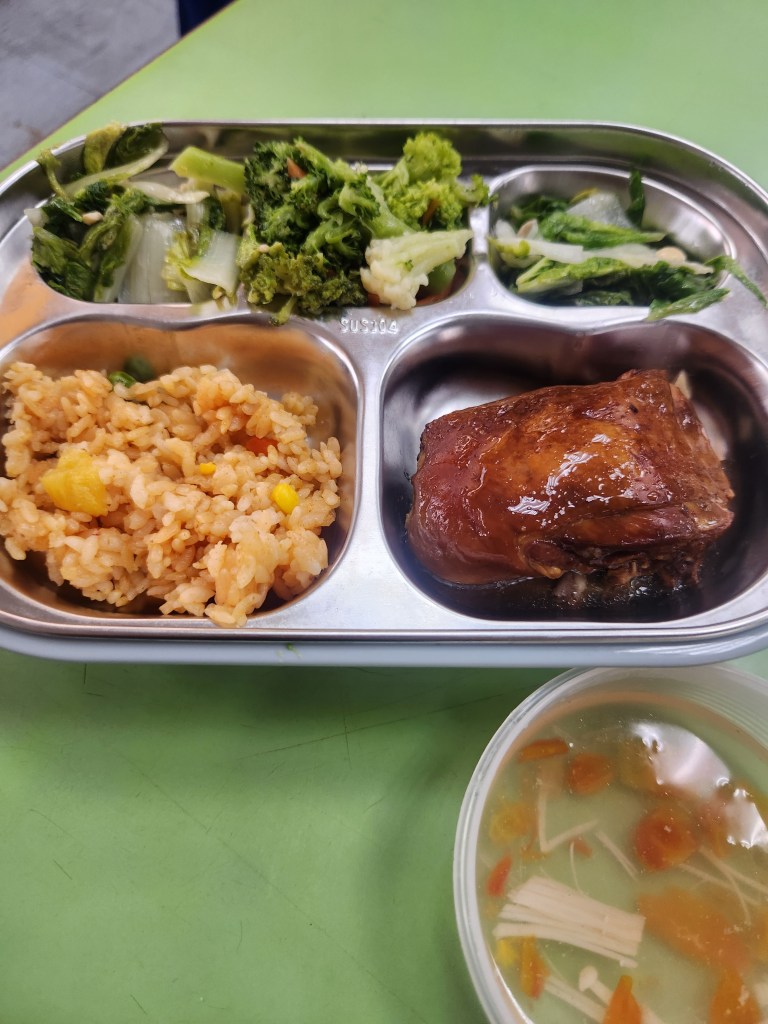
Lunches. The school provides lunches, but only on long days. The lunches are served and eaten in the classroom because there is no cafeteria, and students have to bring their own utensils. The boys have been loving the food, and look forward to it. Lunches usually consist of a rice, protein, vegetables, soup and fruit, and they try to serve different types of cuisines. The boys say it’s “SOOO MUCH BETTER” than the school lunches in the US. 😆 What’s also interesting is that students have to brush their teeth after lunch too!
PTA. Back at our old school in SF, Baba and I were pretty involved with the PTA. It was a great opportunity to help out the school while getting a glimpse into our kids’ day. I didn’t expect schools in Taiwan to have anything like that, but it turns out our school has a “Parent Association” or 家長會. Currently, Baba volunteers as a traffic control guard and I volunteer at the library.
Parents take volunteering seriously here! When you sign up for shift, you are expected to show up that day/time for the entire semester. (Unlike the US, where parent volunteers come and go whenever they please.) Baba had to undergo training for his job and the 家長會 had to buy him insurance. There are also group chats for each volunteer team, and there are multiple messages being sent everyday!
School Fees. In the US, public schools are entirely free (unless you join special clubs, teams or what not.) In Taiwan public school, there are fees. We have to pay for textbooks, school lunches, and bring all supplies. This includes pencils, markers, scissors, glue, and so on. It’s not expensive – we paid less than $200 per kid this semester – but it was a little surprising coming from the US.
However, what’s different in Taiwan is that there are zero school fundraisers. Everything is “paid for” in US schools because families raise funds to support the classrooms. Here, families are responsible for their own expenses. Neither is good or bad, just different!
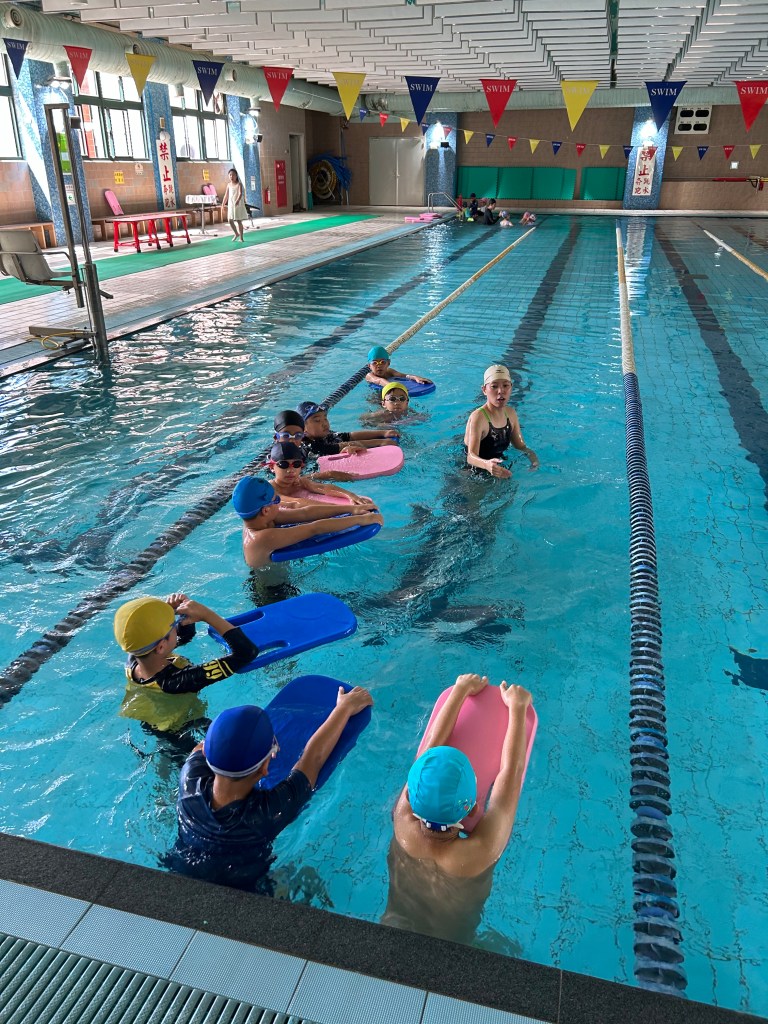
Swim Class. Something really interesting at our school is that it has a pool! Many schools in Taiwan have a pool too, but not all. Students at our school take a 4-week swim class during the semester. I can’t imagine the logistics of trying to get 25 kids in and out of the pool, but I guess the school has figured it out. Kids are grouped by swimming ability. We don’t expect the boys to come out of the class being pro swimmers, but it’s neat that the school has this option.
Afterschool Care. Taiwan schools have afterschool care too, where kids can get homework help. But we felt like C needed 1:1 help in Chinese, so we opted out of this program. However, we were surprised to learn that our school offers A TON of after school activities. There is in-line skating, badminton, ping-pong, magic, track & field, Legos, taekwondo, and much more! We got a little too excited and signed the boys up for something everyday. 😅
But much like the school fees, there are costs to these activities and you have to supply all materials. So we had to purchase in-line skates and helmets, ping-pong paddles and even a deck of cards for O’s magic class.
School Teams. Back in SF, our school had one sports team (soccer) and that was 100% run by parents. Here, our school has several school-run sports teams: basketball, swimming, soccer, badminton, track & field and even theater. But unlike the US, where all kids are accepted into the team (at least in elementary school), there are tryouts here. Not everyone gets in. C says he wants to try out for track & field next semester, so we’ll see.
As I’m writing this post, I realized there are other differences between the schools in the US vs. Taiwan that I haven’t mentioned. Not glaringly different as the ones I’ve listed above, but still interesting. This post is getting too long though, so hopefully I can get to it next time!
I want to interrupt our Europe blogs to share our experience apartment hunting in Taipei. We’ve actually been in Taipei for over 2 weeks now, so I’m obviously very behind in blogging 😅. But there’s just too much that has happened, and I want to document it all before I forget.
If I had to sum up our experience apartment hunting in Taipei, I’d say the overarching theme would be “expectations vs. reality.”
Let’s start with real estate agents.
In the last post about Taiwan, I shared that we’re using a real estate agent to help us look for an apartment. Normally in the US, this would be a DIY effort. We scour the internet to look for listings and work directly with the landlord to rent. Case closed.
Taiwan is different. Not only can we not speak the language, but we’re unfamiliar with the rules, laws and conventions of apartment renting. So, about a week before we left the US, I reached out to an English speaking real estate agency to get on their radar.
There is a cost to working with an agent. If you rent an apartment from the agent, you pay half a month’s rent as a service fee. The service includes negotiating the rental contract, assistance with utilities setup, acting as a liaison between you and landlord for the entire duration of your lease, and some agents can even help with purchasing furniture or appliances.
We told Kathy, our agent, what we were looking for in an apartment:
Ideally, the apartment is in Da’an district
It has 2 bedrooms
Near MRT (Taipei’s metro) or bus stop
At least semi-furnished
At least 30+ pings. Taiwan uses pings 坪 as a measurement of floor space. One 坪 is equivalent to about 35.6 square feet.
About a week before we landed in Taipei and while we were still in Rome, Kathy sent us a list of properties to look at. We were interested in a few of them, but we noticed the listings were all from her agency. We had seen a number of apartments that fit our criteria on rent.591.com.tw (which is equivalent to Craigslist in the US). Why weren’t any of those included?
This is where our expectations did not align with the reality. In the US, your agent can show you any property available. They collaborate with the buyer’s or seller’s agents and split the commission.
In Taipei, agents do not work with each other. If you wanted to view an apartment that isn’t listed under your agent’s realty company, you’d have to contact the representing agent yourself by phone or Line. (Line is the communications app commonly used in Taiwan.) Many times, the agent doesn’t speak English very well so Google Translate quickly became our best friend.
It’s possible for your agent to try and call the landlord and arrange something, but more often than not, the landlord doesn’t want to engage with another agent.
We had expected our agent to be a one-stop solution. She tracks down all apartments that fit our criteria, works with the landlord, negotiates the contract, and voila! We move in. The reality was Baba and I had to do a lot more work ourselves. Almost every night for 2 weeks, we’d scour rent.591.com.tw, create a spreadsheet of potential apartments, contact the different agents and schedule viewings with them. We were on a timeline (we rented an Airbnb for 2 weeks) so we had to act quickly.
On top of all this, we had to consider how the apartment would affect school registration for the boys. I’ll share more about that next.
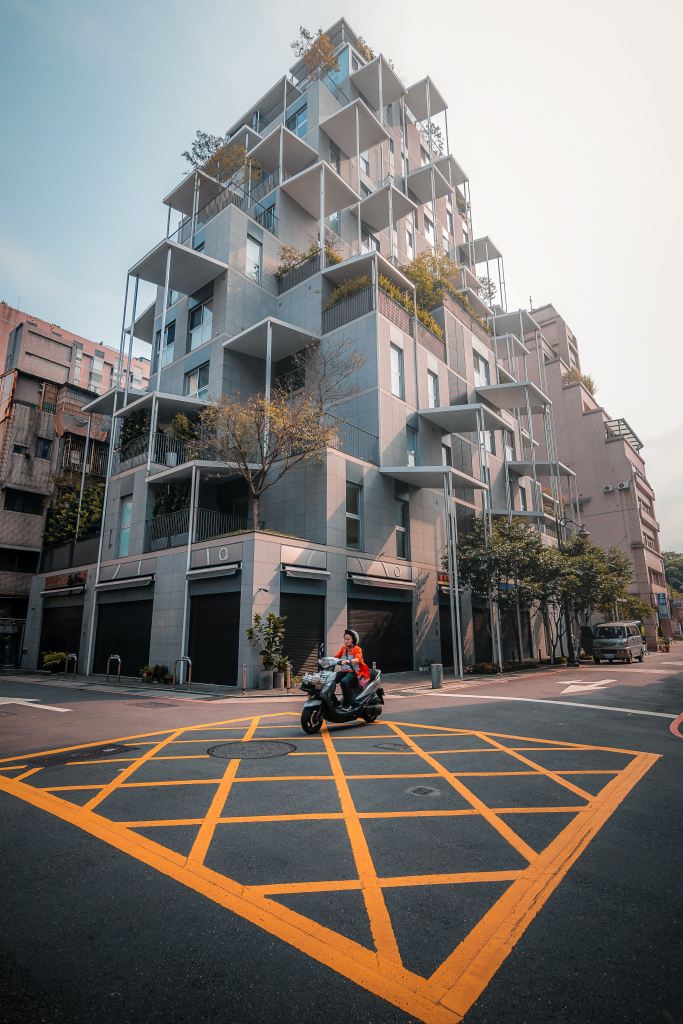
A lot of people asked if we have an apartment in Taipei yet. We don’t! Renting an apartment in Taipei is like anywhere else. Unless you’re willing to start paying rent before moving in, you’ll want to physically be there to check out the area and apartment before signing a lease. So, we rented an Airbnb for the first two weeks of August for apartment hunting. We do have an idea of the district we want to live in (Da’an).
In the middle of our vacation in Madrid, we got our first reality check. Our real estate agent in Taipei asked if she can look for apartments in both Da’an and Xinyi districts. I told her we wanted to concentrate in Da’an because we plan to use our Airbnb address (also in Da’an) to register for a nearby school. Then once we find our own apartment, we will update our address with the school. This is what some expats have done in the past, according to forums I lurk in.
But Kathy, our real estate agent, asked: “Did you ask your Airbnb host if you can use her address to register for school?”
Oh. Whoops.
It turns out our Airbnb host couldn’t let us use her address for school registration. We’re not sure why – maybe that address is already registered with a school – but we had to come up with Plan B, whatever that is.
We struggled with deciding what comes first – do we look for an apartment and then find a school nearby? Or find a school first, and then an apartment? I posed this dilemma on an expat forum and people advised to look for a school first because by the time we arrive in Taipei in August, many of the schools may be full.
Thankfully, a helpful stranger on the forum sent me a PDF of all the schools that were full in Taipei. I did some cursory research on schools that still have space (just based on Google reviews, the school’s website and Facebook page), and narrowed the list down to three. They are all in Da’an or Xinyi districts.
So now, our apartment hunting strategy is to find an apartment within walking distance to any of those schools, which is easier said than done. Apartments apparently get rented out quickly in Taipei so we’ll have to act fast. We have about one month to find an apartment and register for school before school starts on 9/1. We signed up for an adventure and we sure got it!
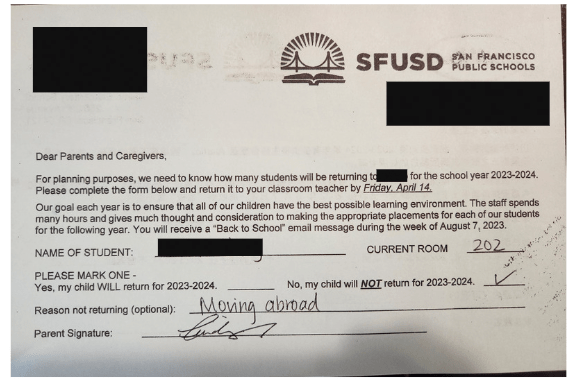
Last week, we submitted notice that we won’t be returning to our school in the fall.
It’s a simple form, but I felt so conflicted filling it out. Even with our first year of kindergarten being completely virtual due to Covid, we found a wonderful, welcoming community at our school. I will miss seeing familiar friendly faces, soccer games and get-togethers, and the 5-minute walk to school.
Besides missing the obvious things like our school, family, and friends, I thought about all the “little” things I will miss about living in SF:
The oven: I LOVE to cook and bake with my oven. However, most Taiwan apartments don’t have ovens but maybe we can get a small convection oven as a compromise?
Food diversity: Taiwan has amazing food but I appreciate the variety of cuisines and ingredients in SF. Now that we’re only 1.5 months away from moving, I’ve been trying to cook and eat foods that will be hard to find in Taiwan (which includes Mexican, Indian and Southern fare).
Weather: I probably complained a little too much about the rain and cold this year but oh, I will yearn for the cool weather in SF when we have to face the typhoons and hot, humid weather in Taipei!
Neighborhood: While our 2-bedroom apartment is nothing to write home about, we love our neighborhood. Close to family, school, parks and grocery stores, the location is so convenient. I’ve heard that everything is incredibly convenient in Taipei so I’m not worried about that while we’re abroad. I just hope that we can find a place just as convenient when we return to the city.
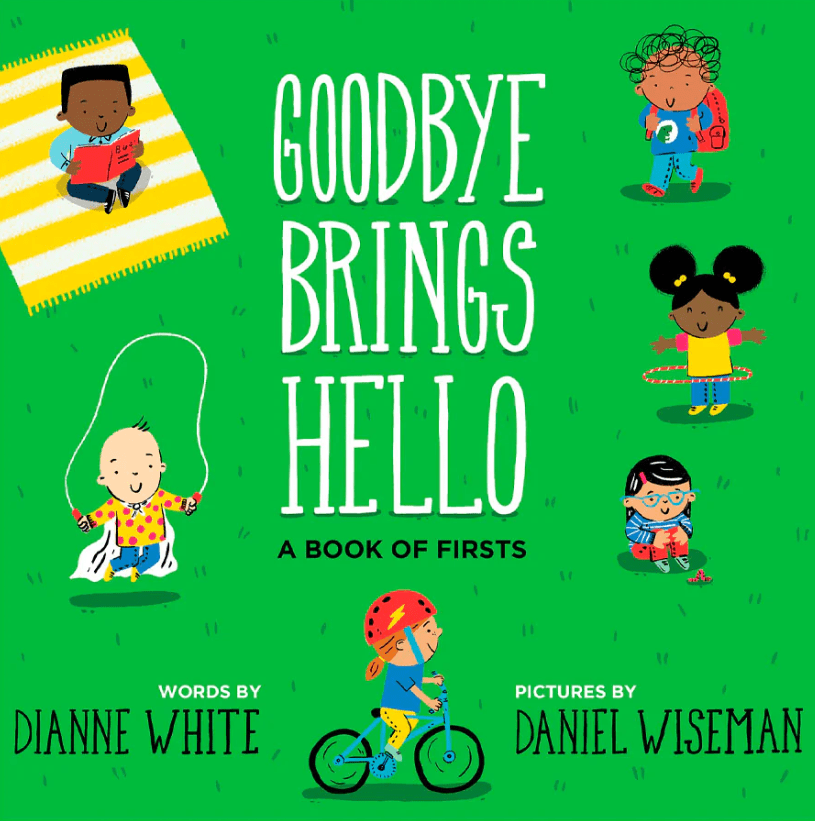
As I get wistful about moving, it’s nice to find encouraging messages in unexpected places. One of those places is in a children’s book called Goodbye Brings Hello. I borrowed a ton of books about moving and dealing with change for C and O, but it turns out I may be the one who needs them most.
“There are many ways of letting go. With each goodbye, a new hello.”
This short but sweet book is about changes in life. It can be so difficult to say goodbye to the familiar. But the beauty is that when we say goodbye to something, we are often saying hello to something else. So as we say goodbye to our friends, school, oven, and neighborhood, we will say hello to many new things and experiences in Taiwan. And those hellos can be fabulous.
Isn’t it funny that as children, we’d kick and scream bloody murder when our parents made us learn Chinese but now that we’re parents, we’re doing the same to our kids? We know the Chinese in Taiwan will be a gazillion times harder than what we ever learned here, so we’re trying our best to prepare the boys.
We started them with online Chinese classes during the pandemic. When school opened back up, we enrolled them in the after school Chinese program. The actual language instruction time isn’t much; it was 30 minutes each week for the online classes, and 1-2 hours each day in the after school program.
Another challenge is that the Chinese taught here is mostly Chinese Mandarin and not Taiwanese Mandarin. While the two languages are very similar, Chinese Mandarin uses simplified characters and Taiwan uses traditional. Chinese Mandarin also uses pinyin while Taiwan uses bopomofo, or zhuyin. The boys have been learning Chinese Mandarin at school.
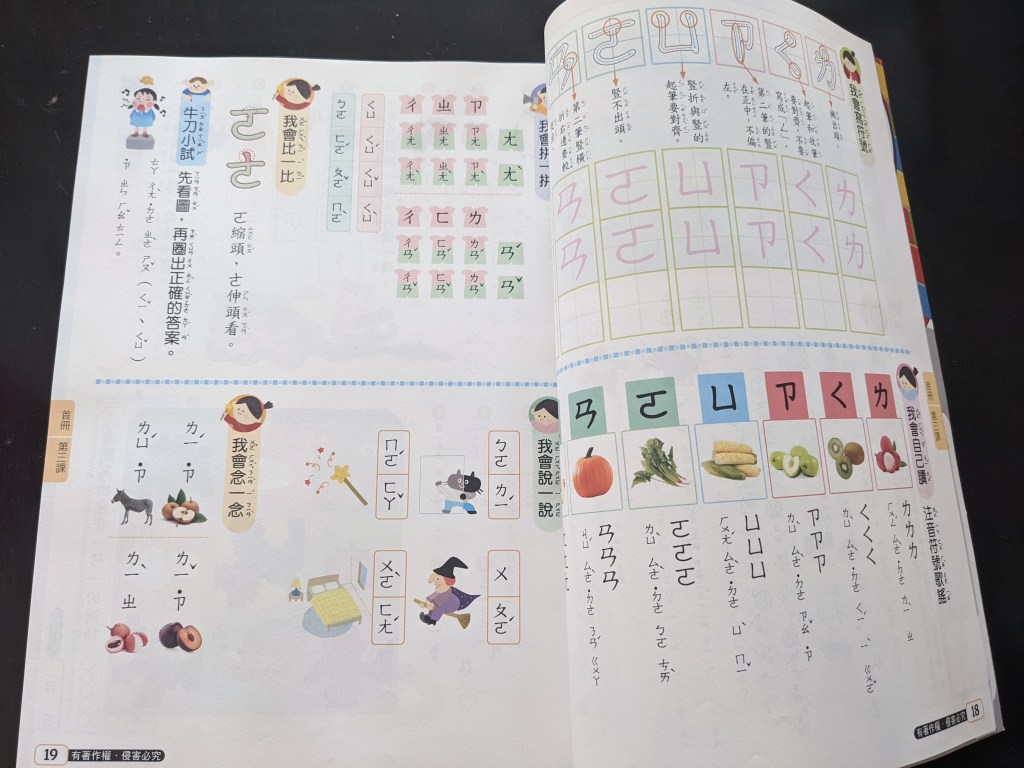
Knowing bopomofo is critical if you attend school in Taiwan. It’s the Taiwanese alphabet phonetic system, so it’s like Americans having to know their ABC’s. Even though my Chinese is limited, I knew I had to at least teach C and O bopomofo.
I first purchased a cute set of bopomofo flashcards on Etsy. Learning 4-5 alphabets a day, I taught myself bopomofo before teaching the boys. They picked it up within 3 weeks.
But the challenge was (and still is) reading bopomofo when the alphabets are strung together. It’s one thing to know your ABCs, but it’s another endeavor to know how to read. On top of this, there are the 5 tones in Chinese which the boys yet have to master.
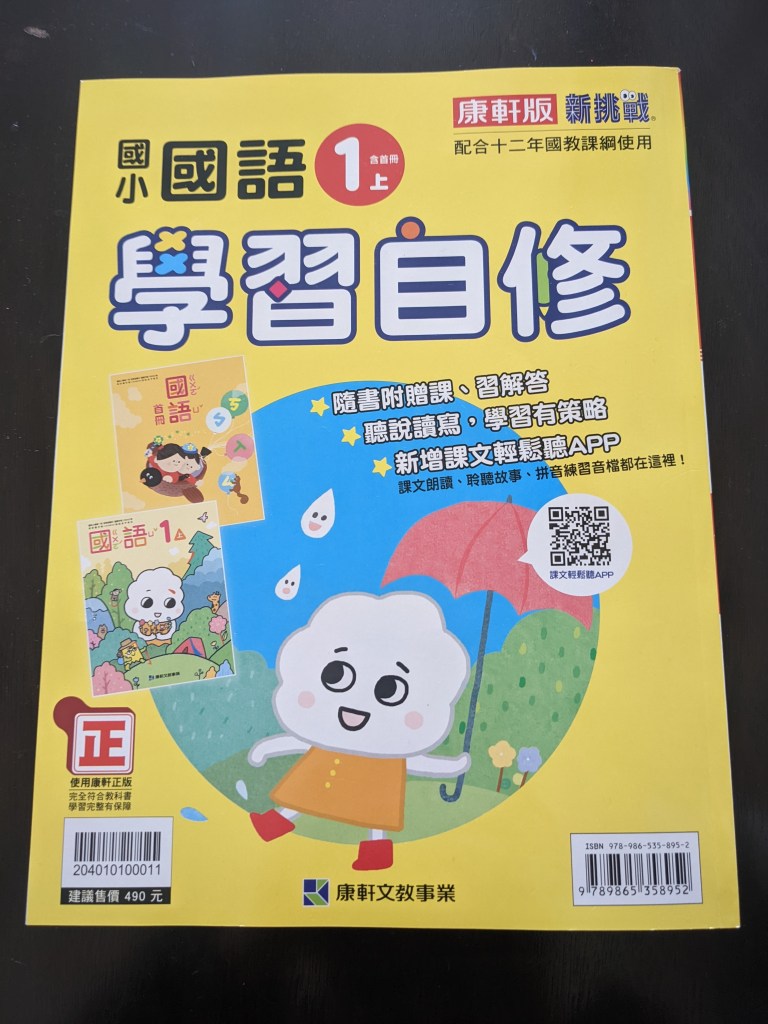
A mom living in Taiwan suggested that I buy a grade 1 textbook to see what the curriculum is like. I purchased a self-study textbook from Kang Xuan, one of Taiwan’s main textbook publishers. The book itself was cheap (~$13 USD) but combine that with international shipping and it came out to $45. What made things worse was that I accidentally bought two copies (d’oh!) because I thought the company cancelled my order. I was eventually able to sell the second copy but at a loss. So my copy of the textbook was actually more like $65, eek.
Unsurprisingly, grade 1 Taiwanese Chinese is pretty damn hard. The first section is purely bopomofo. The boys and I have been trying to do a little each night, but it’s daunting. Even though we can read the bopomofo, there are times we don’t understand what we’re reading.
I much prefer pinyin because it uses Roman alphabets, which is more natural for us to read. With bopomofo, it takes more effort for me to convert the alphabet into the right sounds in my head.
The remaining sections in the textbook are all in Chinese. This is definitely not the same as 1st grade Chinese here in the US, where students are likely learning simple words like 吃飯, 說話, 前面. The textbook uses complex vocabulary and phrases (at least to me they are!). It’s expected because these books are for native Mandarin speakers – it’s just more worrisome for us.
In hindsight, buying the textbook wasn’t the best idea. It’s hard for even me to digest, so how could I use it to teach the boys? I should’ve listened to my parents and learned Chinese when I had the opportunity. Sorry Mom!
Later, I found a free resource with PDF textbooks geared towards Chinese learners. The books have English instructions, with both pinyin and bopomofo. The exercises are a slow and easy ramp up, much more manageable for beginners.
Baba thinks our efforts are futile. The boys will struggle in school no matter what, and I don’t doubt that. In a highly competitive and test-centric school culture like Taiwan, we’ll have to emphasize to the boys that they are doing this for the experience. It doesn’t matter what their grades are. What matters to us is that they remain open-minded, make new friends and absorb as much of the language and culture as they can.
I just hope they’ll remember this when they’re crying over 4 hours of homework each day 😅.
Kids. They bring so much joy but also so many complications. C and O will be 8 and 6 when we land in Taiwan so we have to consider how the move will affect them, both socially and academically.
SOCIAL
Thankfully, I think they’re still young enough to adapt easily yet old enough to remember the experience. Of course, their adaptability will depend a lot on their personalities too. Between the two, I predict C might adapt better socially. He is a happy-go-lucky kid, makes friends easily and is fairly logical when you reason with him. He was initially reluctant about the move, but is starting to understand how unique this experience will be. C is also super excited about all the yummy food in Taiwan too. 🙂
O, on the other hand, is slow to warm up but he’s at an age where he’s content following his older brother and parents around. He can be anxious and stubborn – and as a result, unamenable to new changes, so we’ll have to keep a closer eye on him.
Above all, I think the boys will struggle with not having family around in Taiwan. (And honestly, for us too.) They are incredibly close to their extended family. They are used to having aunts and uncles visit each week, take them on trips and teach them everything from math to reading and writing. We’ve been spoiled, I know. Help from family has been so invaluable the past few years, and it was one of the major reasons why we postponed our move until now. Yet if we wait any longer, then it will be harder for C and O to adapt to a new school. (I’ll explain why below.) There is really no ideal time to move abroad, sigh.
ACADEMICS
It will be interesting to see how the boys adjust academically in Taiwan. Right now they are breezing through elementary school in the US. In Taiwan, we will be putting them in local public school. This was not our original intent. We had considered putting them in private bilingual schools but decided against it for several reasons:
We believe public schools will give the boys a better perspective of Taiwanese people and culture. Private schools are typically full of expats or wealthy families so you are living in a bubble.
We’ve heard from a few expat parents that public schools are the best and fastest way to learn the language. While private schools teach Chinese too, many of them dedicate about half the time to English.
Private schools can be expensive.
Taiwan public schools are notorious for being harsh. There is a lot of homework, tests and rule-following. O will be starting 1st grade which is comparable to kindergarten in the US, so we’re hoping the transition for him will be smoother. (Taiwan elementary schools start with 1st grade. Kindergarten is a separate entity, similar to how preschools are operated here.)
C will be starting 3rd grade, and that worries me much more. This is another reason why we didn’t want to postpone our move further. By the third grade, Taiwanese students are fluent in writing, reading and speaking. There are a few public schools with a CSL (Chinese as a Second Language) program, but we need to be working at a Taiwanese company in order to qualify. If we continue to wait to move, the chances of C catching up in a Taiwanese school are next to none.
Baba and I have no way to help the boys with school, so we will be hiring a tutor to help with homework. I fully expect that there will be a lot of tears and frustration…from me and the boys. I will probably drive myself crazy wondering whether we made the right choice sending them to public school. Guess we’ll just have to see how it goes.





 Hongs Abroad