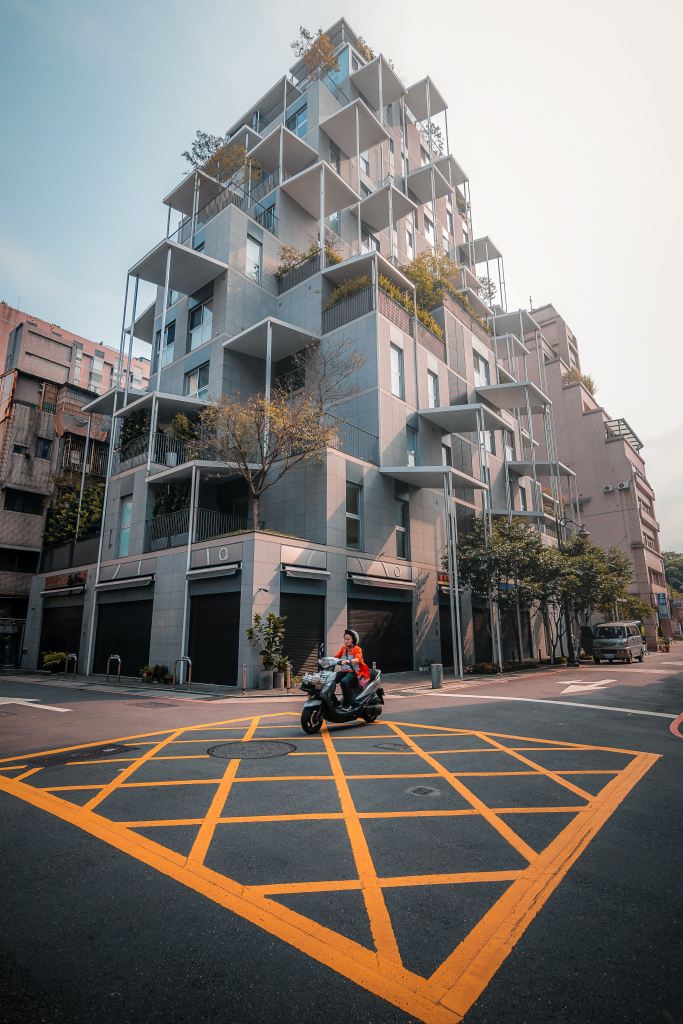
A lot of people asked if we have an apartment in Taipei yet. We don’t! Renting an apartment in Taipei is like anywhere else. Unless you’re willing to start paying rent before moving in, you’ll want to physically be there to check out the area and apartment before signing a lease. So, we rented an Airbnb for the first two weeks of August for apartment hunting. We do have an idea of the district we want to live in (Da’an).
In the middle of our vacation in Madrid, we got our first reality check. Our real estate agent in Taipei asked if she can look for apartments in both Da’an and Xinyi districts. I told her we wanted to concentrate in Da’an because we plan to use our Airbnb address (also in Da’an) to register for a nearby school. Then once we find our own apartment, we will update our address with the school. This is what some expats have done in the past, according to forums I lurk in.
But Kathy, our real estate agent, asked: “Did you ask your Airbnb host if you can use her address to register for school?”
Oh. Whoops.
It turns out our Airbnb host couldn’t let us use her address for school registration. We’re not sure why – maybe that address is already registered with a school – but we had to come up with Plan B, whatever that is.
We struggled with deciding what comes first – do we look for an apartment and then find a school nearby? Or find a school first, and then an apartment? I posed this dilemma on an expat forum and people advised to look for a school first because by the time we arrive in Taipei in August, many of the schools may be full.
Thankfully, a helpful stranger on the forum sent me a PDF of all the schools that were full in Taipei. I did some cursory research on schools that still have space (just based on Google reviews, the school’s website and Facebook page), and narrowed the list down to three. They are all in Da’an or Xinyi districts.
So now, our apartment hunting strategy is to find an apartment within walking distance to any of those schools, which is easier said than done. Apartments apparently get rented out quickly in Taipei so we’ll have to act fast. We have about one month to find an apartment and register for school before school starts on 9/1. We signed up for an adventure and we sure got it!
The time is finally here! What began as a flippant idea has become our new reality. Even though we’ve been planning and talking about this for 5+ years, it’s surreal that in 2 months, we will be living in another country.
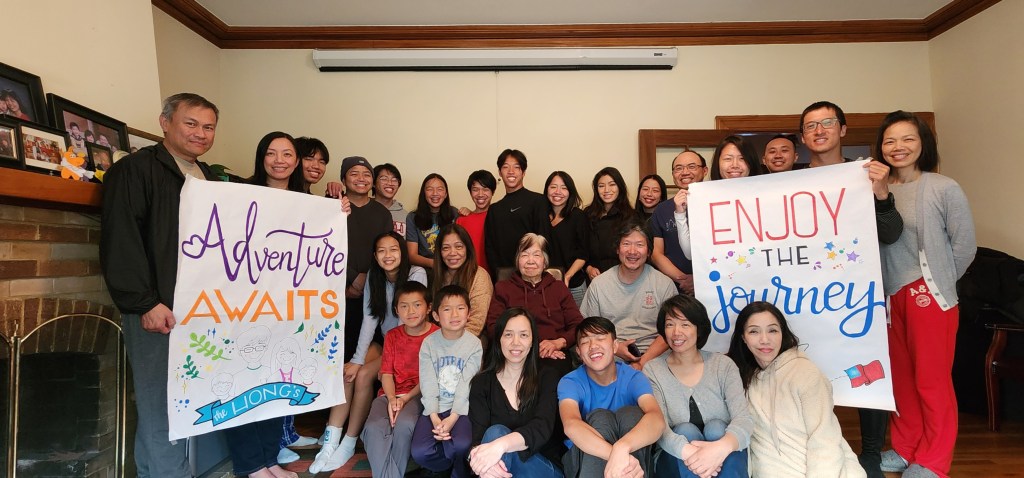
In the past few weeks, we’ve been showered with many dinners, get-togethers and parties from our family and friends. During these moments, I pause and take a look around to appreciate what’s in front of me. I tell myself to remember this moment.
It’s human nature to take things for granted. We take things for granted on a daily basis, always with the assumption that if we need something it will be there. I’m no different.
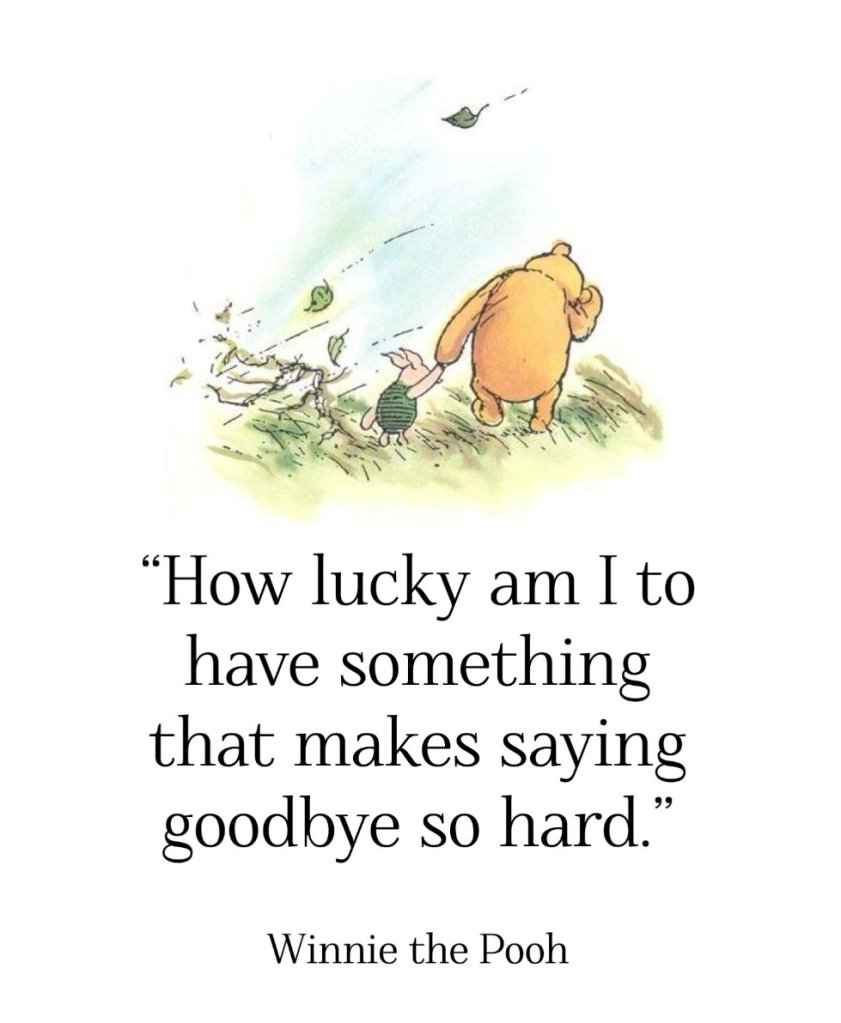
But now we’ve come to a point where the things we are used to having may not be there anymore. So while it’s been incredibly hard to say goodbye, I learned to cherish everything about our life here, big or small – from how warm and cozy our apartment is, to the love and support we have from our family. I guess we sometimes need reminders like this to realize how lucky we are to have something that makes saying goodbye so hard.
Since Baba and I are approved for the Taiwan Gold Visa, we were given a resident authorization certificate.
Upon landing in Taiwan, we will need to go to the National Immigration Agency (NIA) with this certificate and get our official Gold Card and ARC, or Alien Resident Certificate.
Naively, we thought it would be an easy process to get C and O their visas now that both of us are approved. We filled out the dependent visa application online and went to the Taiwan consulate to submit it, along with the required documents: authenticated birth certificates, vaccination records and our marriage certificate. We thought we’d get the boys’ resident visas in a couple of weeks and off we go! Right?
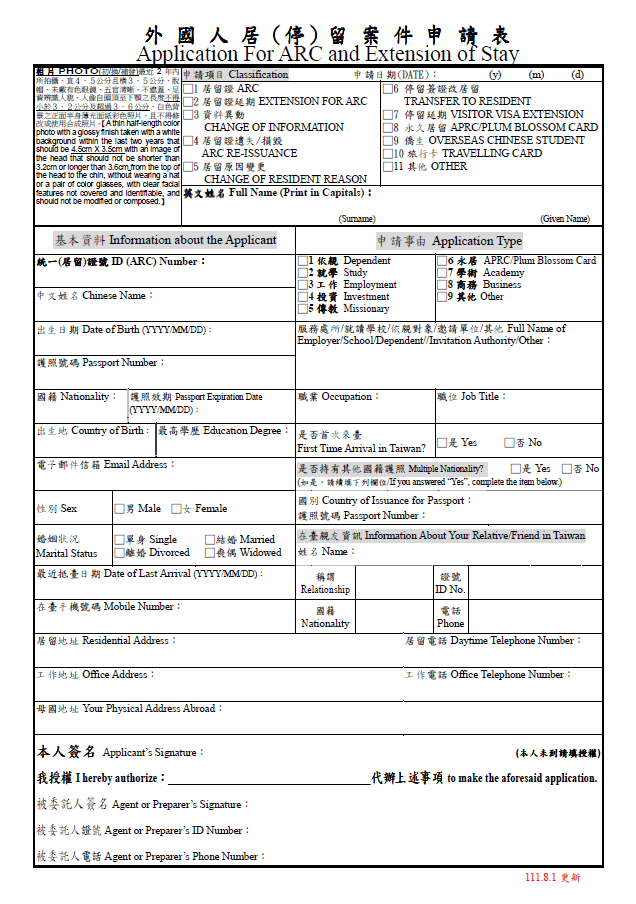
Not quite. We got a call from the Taiwan consulate telling us that the boys’ resident visas will last only 3 months. And since we won’t land in Taiwan until August 1st, they will not approve the visas until early to mid May. We will then need to report to the NIA immediately after arriving in Taiwan to get ARCs for the boys, which requires a separate application. This process can take up to 2 weeks. We need their ARCs in order to register for school so this step is crucial.
We’re honestly still confused as to why we need the resident visa from the Taiwan consulate if it only lasts 3 months, and then have to apply separately for the boys’ ARCs in Taiwan. We thought getting approved for a resident visa = getting an ARC. Baba doesn’t think the Taiwan consulate would mislead us into getting a resident visa if we didn’t need one, so we’re just going along in good faith. Maybe there’s a good reason why people hire immigration lawyers for this stuff. 😅
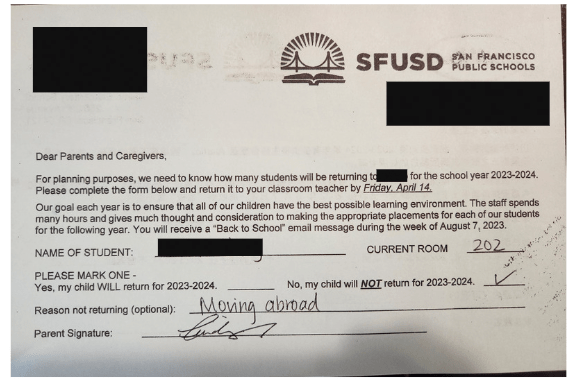
Last week, we submitted notice that we won’t be returning to our school in the fall.
It’s a simple form, but I felt so conflicted filling it out. Even with our first year of kindergarten being completely virtual due to Covid, we found a wonderful, welcoming community at our school. I will miss seeing familiar friendly faces, soccer games and get-togethers, and the 5-minute walk to school.
Besides missing the obvious things like our school, family, and friends, I thought about all the “little” things I will miss about living in SF:
The oven: I LOVE to cook and bake with my oven. However, most Taiwan apartments don’t have ovens but maybe we can get a small convection oven as a compromise?
Food diversity: Taiwan has amazing food but I appreciate the variety of cuisines and ingredients in SF. Now that we’re only 1.5 months away from moving, I’ve been trying to cook and eat foods that will be hard to find in Taiwan (which includes Mexican, Indian and Southern fare).
Weather: I probably complained a little too much about the rain and cold this year but oh, I will yearn for the cool weather in SF when we have to face the typhoons and hot, humid weather in Taipei!
Neighborhood: While our 2-bedroom apartment is nothing to write home about, we love our neighborhood. Close to family, school, parks and grocery stores, the location is so convenient. I’ve heard that everything is incredibly convenient in Taipei so I’m not worried about that while we’re abroad. I just hope that we can find a place just as convenient when we return to the city.
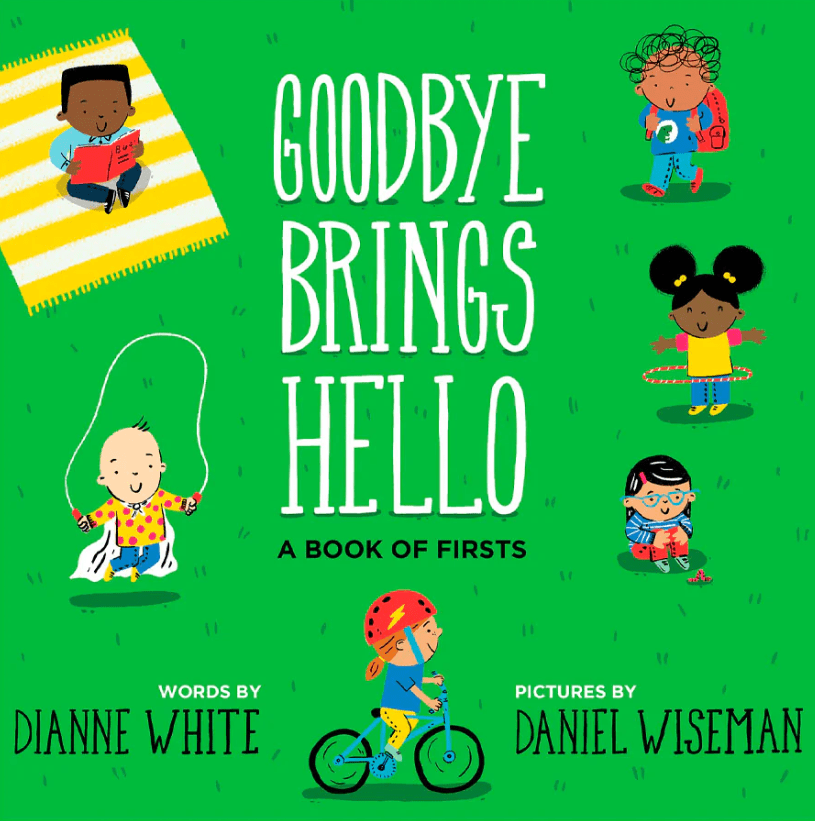
As I get wistful about moving, it’s nice to find encouraging messages in unexpected places. One of those places is in a children’s book called Goodbye Brings Hello. I borrowed a ton of books about moving and dealing with change for C and O, but it turns out I may be the one who needs them most.
“There are many ways of letting go. With each goodbye, a new hello.”
This short but sweet book is about changes in life. It can be so difficult to say goodbye to the familiar. But the beauty is that when we say goodbye to something, we are often saying hello to something else. So as we say goodbye to our friends, school, oven, and neighborhood, we will say hello to many new things and experiences in Taiwan. And those hellos can be fabulous.
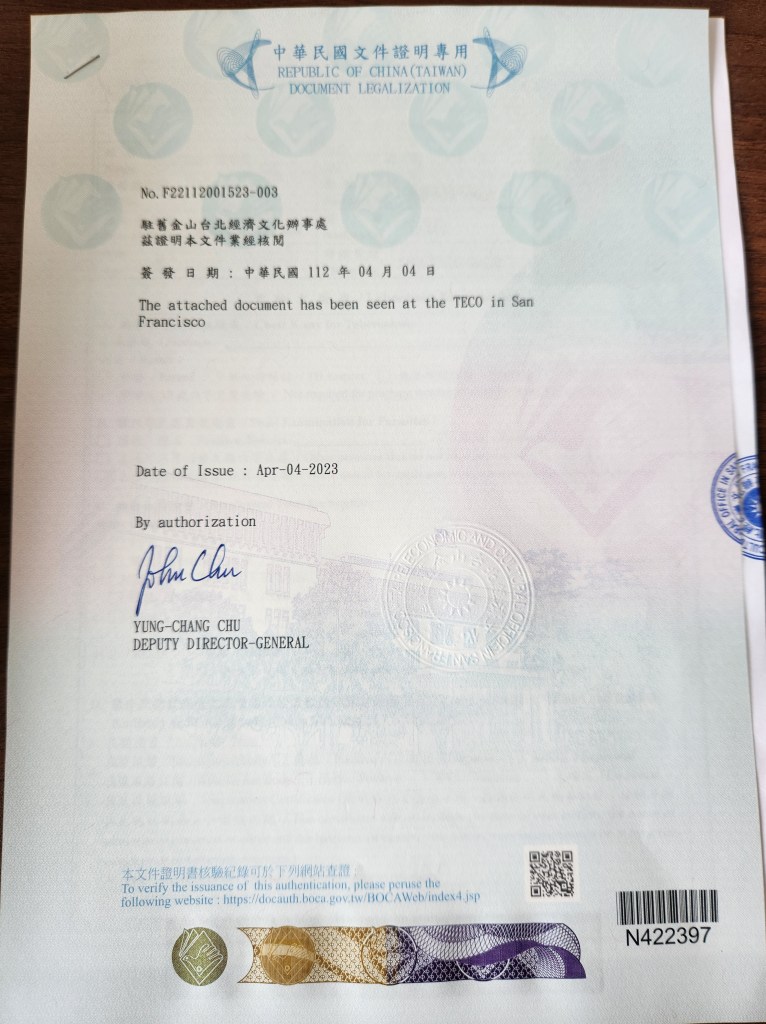
Within a week of going to the Taiwan consulate, we received our authentication certificates in the mail! They attached an official letter to each of the documents we needed to authenticate, which included the boys’ birth certifications and vaccination records.
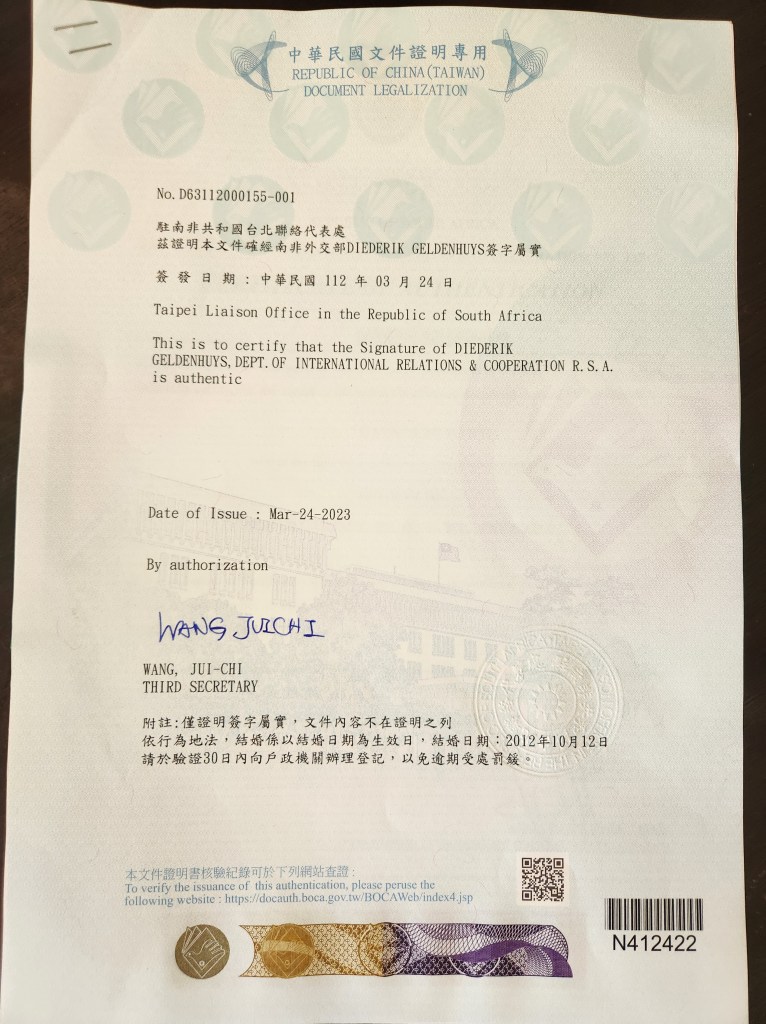
Better yet, we also received our marriage certificate authentication from South Africa yesterday – yay! A letter with similar language was attached, but there were additional certificates with stamps and seals in the packet. Looks so official and all.
But the best news of all is….Baba’s visa application got approved!! After 2.5 months of waiting and following up, Baba finally got his very own Taiwan Gold Card Visa. That means he won’t need to go through the health exam (although we probably should still get his lung checked out 😆), and he would be able to work in Taiwan if he wants to.
This morning, Baba went into the SF Taiwan consulate to submit his passport for inspection. Once that’s approved, he will receive his temporary Gold Card and we can apply for the boys’ visas.
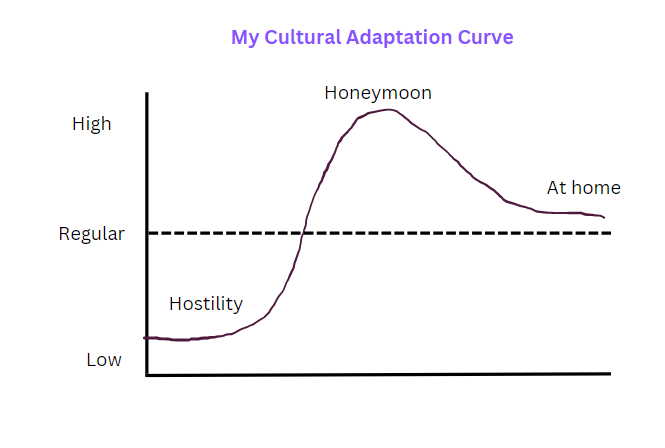
This is a graph I often see that illustrates how foreigners adapt to a new place over time. Most expats start off in a blissful, honeymoon stage for the first couple of months. Everything about their new home is amazing and new. But resentment starts to sets in after people can’t fully assimilate to the culture, have difficulty learning the language or making new friends. Now everything seems so complicated and they get frustrated. It’s not until 6 months after the move that expats come to terms with all the upsides and downsides of their new home.
However, this is what I envision my adjustment will be like:
Apologize for my terrible graph-making skills 😅
I can pretty much guarantee things are going to be rough the first couple of months. We’re arriving during hottest month of the year (August) and will be stressing out about finding an apartment and registering the kids for school. Accomplishing these things will not be easy. We won’t have jobs in Taiwan so landlords might be hesitant renting to us. Similar to the US, school assignments usually come out in March. By August, a lot of schools will be full so we might not get a school of our choice. Then, the boys will have to get adjusted to a new school in a new country, but I know I am the one who will have the hardest time adjusting.
It’s also inevitable I will compare our life in Taipei to what we had in SF. I will long for the mild SF weather, our 5-minute commute to school, our friends, our neighborhood and of course, our family. I will miss how easy everything was for us back home, and question if we made the right choice everyday. I have to remember to be patient with myself.
Eventually though, we will find our rhythm and a community in Taipei (we’d have to!). We will learn to appreciate how wonderful this experience is and everything will be great until the newness of it all wears off. Then, life will feel normal again.
This isn’t me overthinking because throughout most changes in my life – whether it be starting grad school, changing jobs or having a baby – I go through these exact emotions. I start off being a Debbie Downer, but once I meet new friends and/or find my groove, I am happy. I just hope my “hostility” stage won’t last very long, and I’m able to enjoy our time in Taipei as long as possible.
Whew, it’s been a minute! I have some good news and bad news. First, the good news: my application is approved! I’m now officially a Taiwan Gold Card Visa holder. Bad news: Baba’s application is still in limbo and there are still so many things to do before we can all officially move to Taiwan.
Our visa application process hasn’t exactly been a walk in the park. A couple of weeks after I submitted my employment certificate, I received a response that my application does not belong under the Field of Economy but rather the Field of Finance because my former employer is in the insurance brokerage industry. The problem was, I wouldn’t exactly qualify under the Field of Finance. In addition to needing to have earned NT$160,000 a month, I would need some kind of financial expertise which I don’t have.
We decided to write a letter of appeal. I argued that while the my company could be classified under the financial industry, my job responsibilities and degrees are purely in business.
Meanwhile, Baba also received a similar response. His application under the Field of Economy was denied but they offered to do a special review with the National Development Agency. We learned that this process could take 1-2 months. We were already approaching March and plan to leave on June 3rd so we didn’t have the luxury of waiting.
We felt stuck. Doubt started to seep in and I was stressed. We started googling visa requirements for Spain. Although we could qualify for their Non-Lucrative Retirement Visa, timing would be extremely tight. And do we apply for Spain while waiting to hear back from Taiwan? How much time should we give Taiwan to get back to us? Is there anything we can do now for Spain’s application that is easy and low-cost in case our Taiwan visa gets approved? Why didn’t we apply for our visa earlier?! We had many questions but no answers.
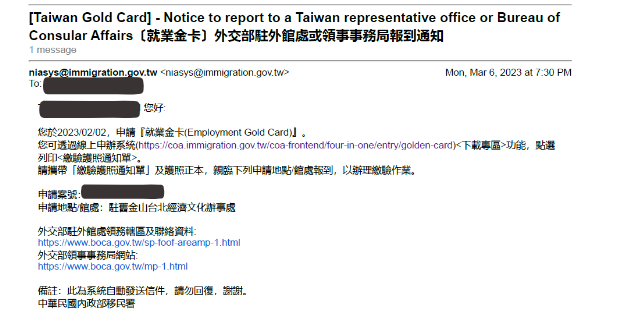
But then, on the evening of March 6, I received the fantastic news: my application got approved! The next step was to submit my passport for inspection, and go through a final review by the National Immigration Agency. On March 15, I received my temporary Taiwan Gold Card. (I will need to pick up the official Gold Card when we’re in Taiwan.)
Baba’s application is still under review. At this point, he had written a letter to the visa office with more information about his work experience and education. He requested that his application be approved under the Field of Finance since his former employer is in the finance industry and he had worked closely with finance managers.
Initially, the visa office denied Baba’s request to move his application to the Field of Finance. They told him they need to do a further review of his “unique expertise.” But just this morning, Baba received an update that he could apply under the Field of Finance. Wish they could’ve made this decision when we made the initial request – that could’ve saved us 2 weeks!!
At this point, Baba could technically apply as my spouse but he won’t be able to work in Taiwan and there is more administrative work. For one thing, he would need to get a health examination that includes a chest x-ray, syphilis test, skin exam, among other things. He would then need to get a health certificate from his doctor and get the certificate “authenticated” by the Taiwan consulate. For now, our plan is to do two things at once: Baba re-applies under the Field of Finance and goes through the health exam in case the former option doesn’t work out.
But wait, there’s more! We have kids! Before we can apply for visas for C and O, Baba and I have to prove that we’re married. (Apparently, Taiwan doesn’t recognize children born out of wedlock 😆.) But the joke is on us, because our marriage certificate is from South Africa which complicates things a bit. All documents issued outside of Taiwan must be authenticated by the Taiwan consulate from where the document originated. Well, we obviously don’t live in South Africa so we had to hire an agent to help us with the authentication process of our marriage certificate. The Taiwan consulate in SA sent us a list of agents, so I contacted one, wired him money and prayed that this isn’t some elaborate scam. Our agent told us the process can take 4-5 weeks so we continue to wait.
In addition to the marriage certificate, we have to provide and authenticate C and O’s birth certificates and vaccination records. We also had to get a health exam and certificate for C, which of course needs to be authenticated too. (Children under 6 years do not have to get a health exam so O is spared.) Thankfully, since these documents were all issued in the SF Bay Area, we can bring them to the Taiwan consulate in San Francisco ourselves. And this all needs to be done before we fill out the actual visa application for the boys!
At the very least, my application is approved so there’s a high chance the rest of the family can get their visas too. But there’s still so much do to before we get there. I’ll post another update as things move along!
A few days after we submitted our visa application, we received a request to submit supplementary documents.
“Your CV was not considered as work certificate and was not accepted. Please provide local or foreign employment certificate with related work contents in economic industries or field. And the certificate shall be issued by the company shown on your tax statement which paid salary and hired you in the financial year. Also, the certificate shall have your employment period, work position and content, company logo, company information and signature of person or supervisor in-charge.”
At first glance, I thought this sounded concerning. Did we make a mistake on our application? Did they find something suspicious?!
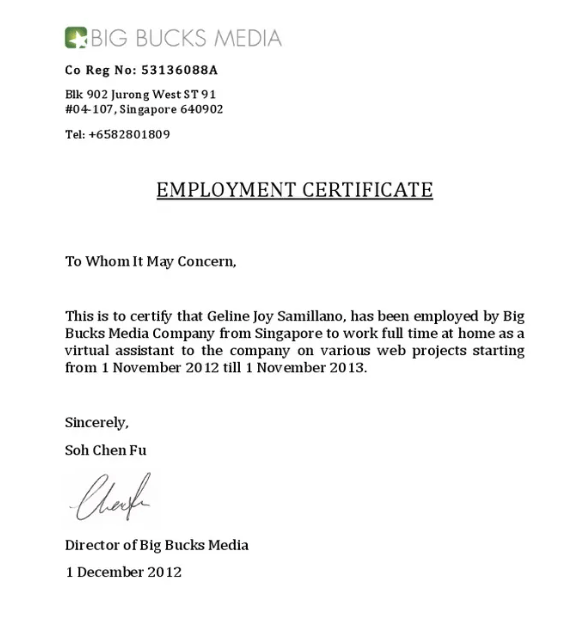
Though uncommon in the US, it turns out that an employment certificate is a customary practice in Taiwan. The certificate is basically a short letter in which your company verifies what you wrote on your resume is true. It needs to be on company letterhead and signed by HR or your supervisor. Thankfully, we just needed to provide one employment certificate. The certificate had to be from the company that is on the W-2 we submitted.
Example of an employment certificate:
Worried that our old employers would be confused about an employment certificate, Baba and I drafted a letter they could repurpose. Fortunately, both companies seemed unfazed by it and sent back a signed certificate/letter within a few days. Whew, one hurdle down! We uploaded the certificate in the applicant portal and again, now we wait.
Isn’t it funny that as children, we’d kick and scream bloody murder when our parents made us learn Chinese but now that we’re parents, we’re doing the same to our kids? We know the Chinese in Taiwan will be a gazillion times harder than what we ever learned here, so we’re trying our best to prepare the boys.
We started them with online Chinese classes during the pandemic. When school opened back up, we enrolled them in the after school Chinese program. The actual language instruction time isn’t much; it was 30 minutes each week for the online classes, and 1-2 hours each day in the after school program.
Another challenge is that the Chinese taught here is mostly Chinese Mandarin and not Taiwanese Mandarin. While the two languages are very similar, Chinese Mandarin uses simplified characters and Taiwan uses traditional. Chinese Mandarin also uses pinyin while Taiwan uses bopomofo, or zhuyin. The boys have been learning Chinese Mandarin at school.
Knowing bopomofo is critical if you attend school in Taiwan. It’s the Taiwanese alphabet phonetic system, so it’s like Americans having to know their ABC’s. Even though my Chinese is limited, I knew I had to at least teach C and O bopomofo.
I first purchased a cute set of bopomofo flashcards on Etsy. Learning 4-5 alphabets a day, I taught myself bopomofo before teaching the boys. They picked it up within 3 weeks.
But the challenge was (and still is) reading bopomofo when the alphabets are strung together. It’s one thing to know your ABCs, but it’s another endeavor to know how to read. On top of this, there are the 5 tones in Chinese which the boys yet have to master.
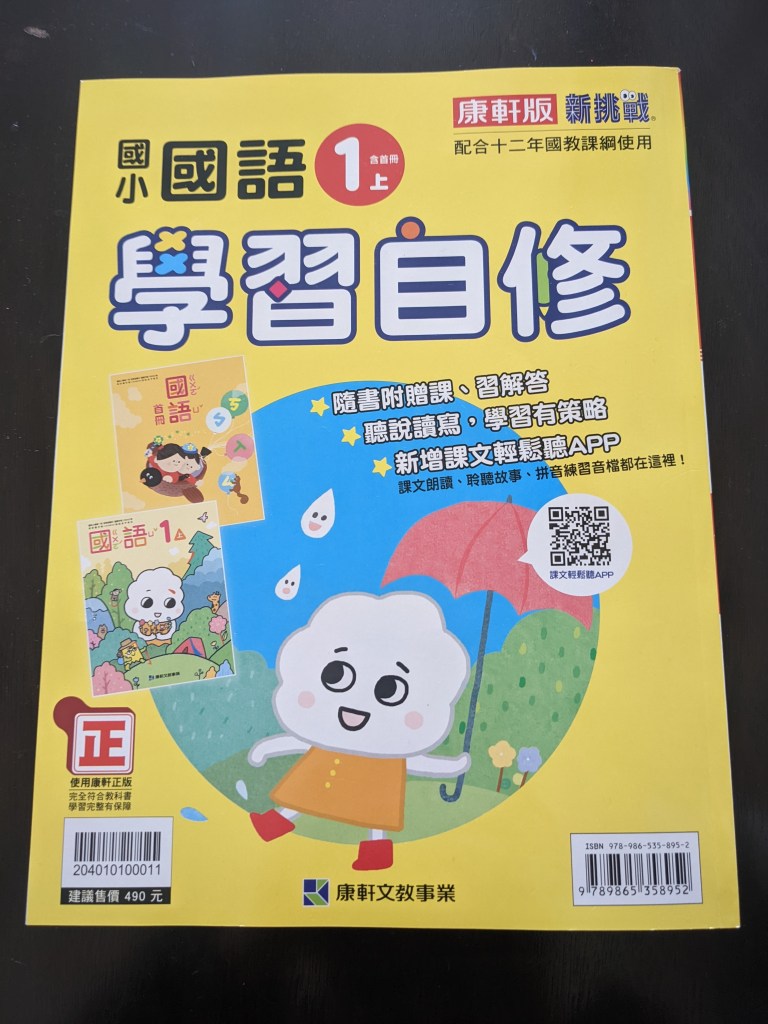
A mom living in Taiwan suggested that I buy a grade 1 textbook to see what the curriculum is like. I purchased a self-study textbook from Kang Xuan, one of Taiwan’s main textbook publishers. The book itself was cheap (~$13 USD) but combine that with international shipping and it came out to $45. What made things worse was that I accidentally bought two copies (d’oh!) because I thought the company cancelled my order. I was eventually able to sell the second copy but at a loss. So my copy of the textbook was actually more like $65, eek.
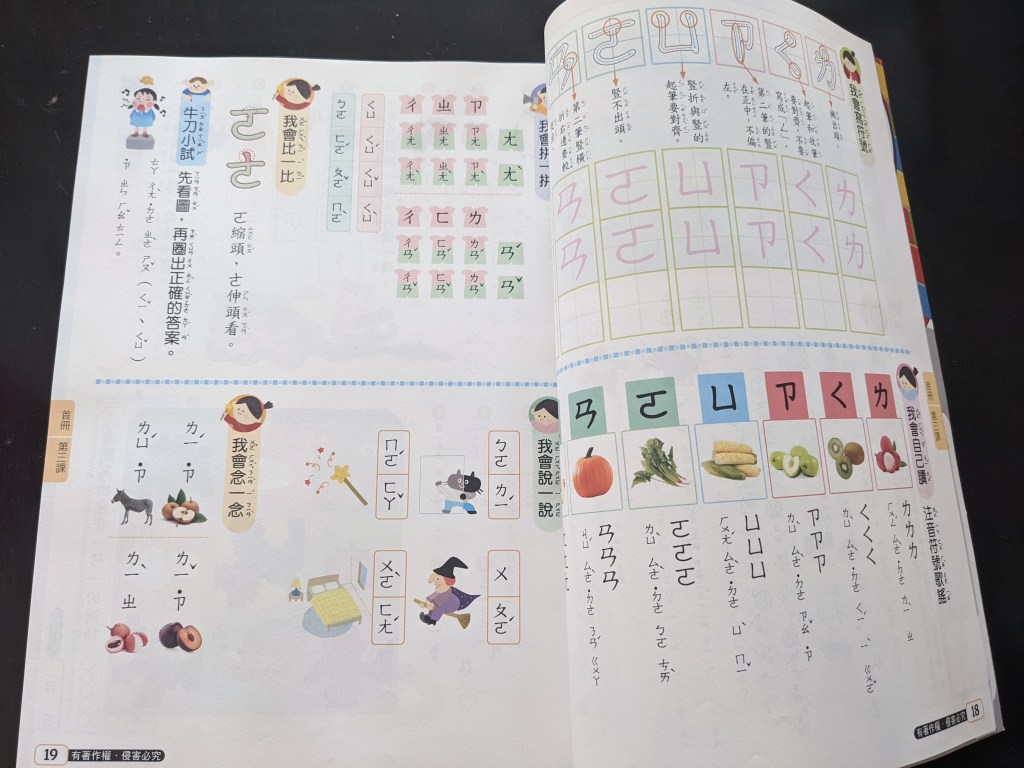
Unsurprisingly, grade 1 Taiwanese Chinese is pretty damn hard. The first section is purely bopomofo. The boys and I have been trying to do a little each night, but it’s daunting. Even though we can read the bopomofo, there are times we don’t understand what we’re reading.
I much prefer pinyin because it uses Roman alphabets, which is more natural for us to read. With bopomofo, it takes more effort for me to convert the alphabet into the right sounds in my head.
The remaining sections in the textbook are all in Chinese. This is definitely not the same as 1st grade Chinese here in the US, where students are likely learning simple words like 吃飯, 說話, 前面. The textbook uses complex vocabulary and phrases (at least to me they are!). It’s expected because these books are for native Mandarin speakers – it’s just more worrisome for us.
In hindsight, buying the textbook wasn’t the best idea. It’s hard for even me to digest, so how could I use it to teach the boys? I should’ve listened to my parents and learned Chinese when I had the opportunity. Sorry Mom!
Later, I found a free resource with PDF textbooks geared towards Chinese learners. The books have English instructions, with both pinyin and bopomofo. The exercises are a slow and easy ramp up, much more manageable for beginners.
Baba thinks our efforts are futile. The boys will struggle in school no matter what, and I don’t doubt that. In a highly competitive and test-centric school culture like Taiwan, we’ll have to emphasize to the boys that they are doing this for the experience. It doesn’t matter what their grades are. What matters to us is that they remain open-minded, make new friends and absorb as much of the language and culture as they can.
I just hope they’ll remember this when they’re crying over 4 hours of homework each day 😅.
I have no doubt Madrid would be an amazing experience but ultimately, we thought we’d feel most “at home” in Taipei. We understand Asian culture, have some exposure to the language and are happy to binge on dumplings, hot pot and noodles all day!
Many people have asked if we chose Taiwan because we have family there. We don’t! We have zero ties to Taiwan. We are Chinese, but our parents were born in China and Vietnam. We chose Taiwan because it fit most of our criteria.
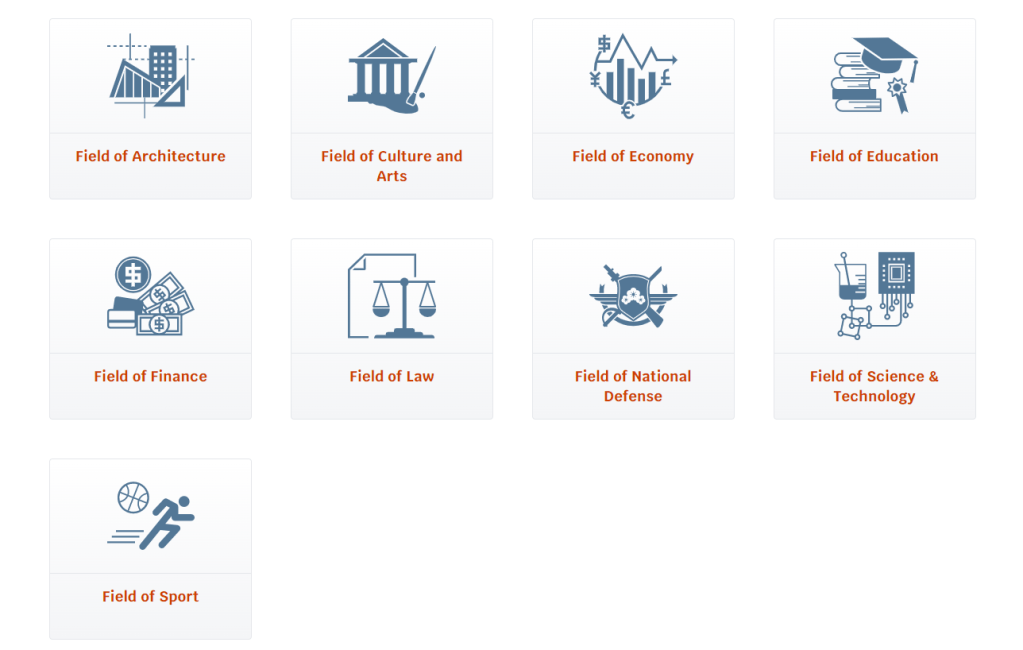
We just submitted our application for the Taiwan Gold Card Visa. This work/resident visa allows the entire family to stay in Taiwan for up to 3 years, and access to Taiwan’s National Health Insurance system, which is supposed to be top notch. To qualify for the visa, you must have worked in the following fields:
Each field has its own requirements. We are applying under the Field of Economy aka business. Within this field, you must have either worked in specific roles or made a monthly salary of NT$160,000 (or $5,400 USD) in the past 3 years. Because of a huge influx of visa applications during the pandemic, Taiwan now requests a curriculum vitae to verify that applicants are working or have worked in relevant fields/industries. But comparatively speaking, the requirements are pretty straightforward.
The application itself was easy too. Aside from having to update our resumes, the application had only 5 sections and took about 30 minutes to complete. There are also step-by-step instructions, and live support via email and chat.
The visa application review process takes about 2 months so now….we just wait. The immigration agency might come back and request additional documents or worse, reject our application. (In which case, Spain here we come?!) Some people asked why we didn’t apply sooner. The 3-year time limit for the visa starts the day your application is approved and not from the day you arrive in Taiwan. If we were to stay the full 3 years, we’d want the boys to finish the school year, which would be around the time our visa application gets approved (assuming all things go as planned). Fingers crossed this all goes smoothly!








 Hongs Abroad